

Can your facility's current procurement strategy survive a sudden shift in global logistics, or is your inventory one delay away from a critical shortage? Hospital procurement managers know that securing bulk n95 respirators for hospitals involves more than just price comparisons. It requires a commitment to sourcing the N95 respirator (NIOSH-approved) through verified channels to ensure a resilient, 12-month supply chain. You need a partner that anticipates disruptions before they reach the loading dock.
This guide provides a professional roadmap for institutional procurement in September 2026. We examine the latest National Institute for Occupational Safety and Health (NIOSH) standards and the recent Food and Drug Administration (FDA) regulatory updates designed to streamline equipment verification. You'll gain the technical insights needed to eliminate counterfeit risks and manage complex international customs. This ensures your frontline staff has access to verified, high performance personal protective equipment (PPE) without interruption while maintaining operational continuity for your hospital.
Key Takeaways
- Identify the critical technical differences between standard surgical masks and a National Institute for Occupational Safety and Health (NIOSH-approved) N95 respirator to ensure regulatory compliance.
- Navigate the complexities of sourcing bulk n95 respirators for hospitals by applying rigorous verification criteria to licensed medical distributors and manufacturers.
- Optimize your inventory management by understanding palletization logistics and the strategic use of Less Than Truckload (LTL) and Full Truckload (FTL) shipping methods.
- Secure long-term price stability in September 2026 by leveraging wholesale case range structures and Blanket Purchase Orders (BPO) to mitigate supply chain volatility.
What are Bulk N95 Respirators for Hospital Use?
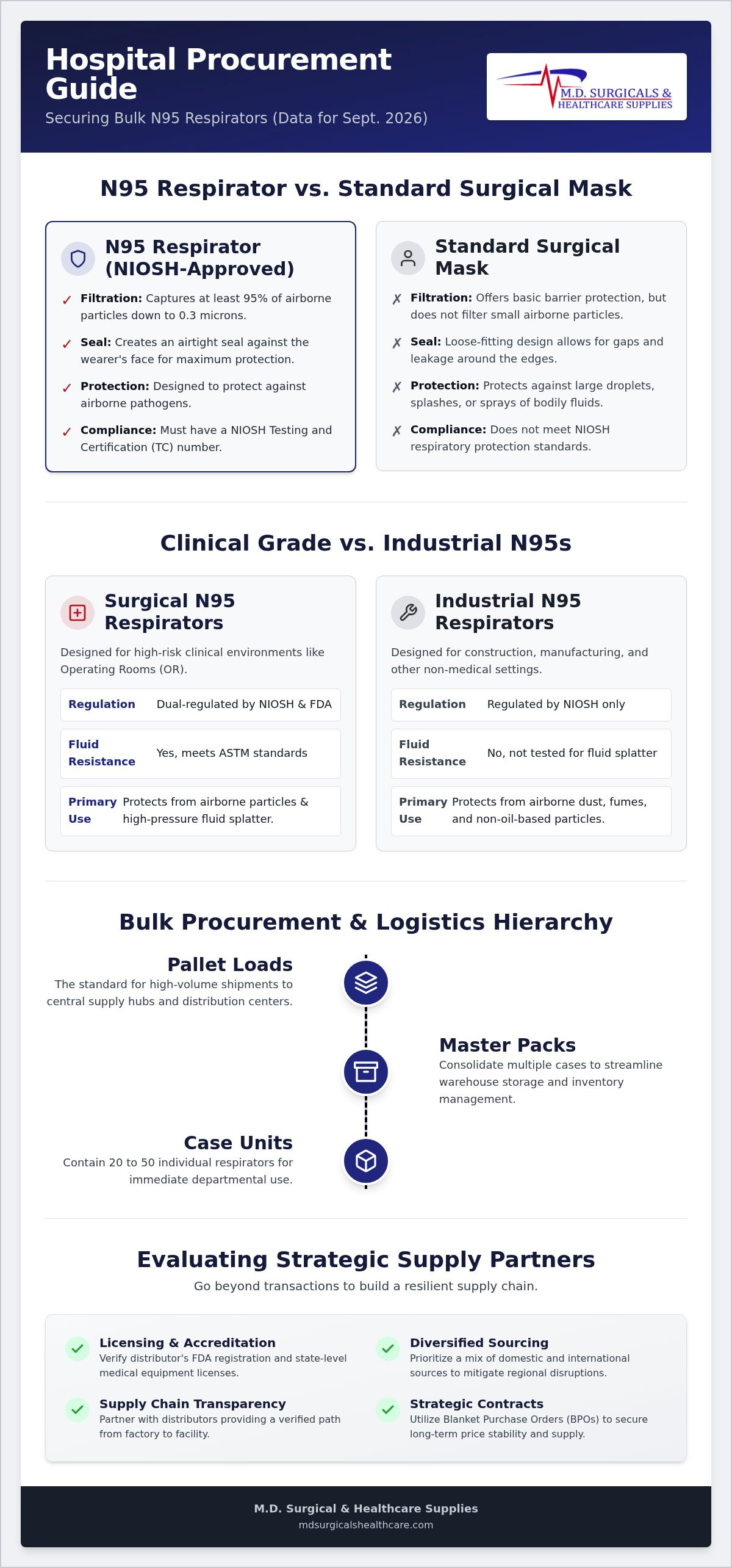
In September 2026, the N95 respirator (NIOSH-approved) remains the clinical gold standard for protection against airborne pathogens in healthcare settings. An N95 respirator is a specialized particulate-filtering device engineered to create a physical seal against the wearer's face, capturing at least 95 percent of particles as small as 0.3 microns. For medical institutions, the procurement of bulk n95 respirators for hospitals typically occurs at the case, master pack, or pallet level. This volume-based approach is necessary to maintain the high-capacity inventory required for daily operations. While standard surgical masks offer basic barrier protection against large droplets, they don't provide the high-level filtration or the airtight seal required for high-risk clinical zones.
Institutional procurement typically follows a structured hierarchy to ensure logistical efficiency:
- Case units: Containing 20 to 50 individual respirators for immediate departmental use.
- Master packs: Consolidating multiple cases to streamline warehouse storage.
- Pallet loads: The standard for high-volume bulk n95 respirators for hospitals shipments to central supply hubs.
NIOSH Approval and Regulatory Compliance
The National Institute for Occupational Safety and Health (NIOSH) manages the rigorous testing protocols for respiratory protection under 42 CFR Part 84. Every authentic unit must display a Testing and Certification (TC) number, which allows your procurement team to verify the equipment through the official records of the Centers for Disease Control and Prevention (CDC). This system ensures that every piece of Personal Protective Equipment (PPE) in your facility meets federal safety benchmarks. By September 2026, many hospital bylaws have moved away from temporary crisis standards, strictly mandating NIOSH-approved hardware. International alternatives, such as KN95 or FFP2 models, frequently fail to meet these local compliance requirements because they lack the specific head-strap tension and filtration consistency required by United States regulatory bodies.
Surgical versus Industrial N95s
It's critical to distinguish between industrial-grade respirators and those cleared for use in an Operating Room (OR). Surgical N95s are dual-regulated, meeting both filtration standards and specific fluid resistance criteria to protect clinicians from high-pressure blood splatter. These medical-grade devices are tested against American Society for Testing and Materials (ASTM) standards for fluid penetration, flammability, and biocompatibility. Products like the Dukal N95 Mask Surgical Mask N95 Respirator are designed specifically for these high-risk environments, combining respiratory protection with a single splash-resistant outer layer. Selecting the appropriate protection level for different hospital departments ensures that staff members are equipped for their specific clinical tasks without compromising safety.
Evaluating Wholesale N95 Manufacturers and Distributors
Selecting a strategic partner for bulk n95 respirators for hospitals requires a move beyond simple transactional vendor relationships. In September 2026, procurement professionals must evaluate distributors based on their logistical infrastructure and their ability to maintain transparency across the entire supply chain. A reliable distributor doesn't just offer products; they provide a verified path from the factory floor to your loading dock. This level of oversight is necessary to protect your facility from the volatility of the global PPE market.
You should prioritize partners who demonstrate a mix of domestic and international sourcing flexibility to mitigate regional disruptions. This diversification is the only way to ensure that a local labor strike or a shipping lane closure doesn't result in a stockout for your facility. Strategic partners act as a logistical backbone, managing the complexities of global distribution on your behalf. M.D. Surgical & Healthcare Supplies maintains this global reach to ensure your operations remain uninterrupted.
Distributor Licensing and Accreditation
Your first step in verification is confirming the distributor's FDA registration and their specific state-level licensing for medical equipment. These credentials ensure that the entity operates within the legal framework required for clinical supply. Following FDA guidelines on N95 respirators is essential for maintaining hospital liability standards and patient safety. Grey market resellers often lack these certifications, posing a significant risk of introducing counterfeit hardware into your inventory. For global procurement, adherence to World Health Organization (WHO) standards provides an additional layer of security for international shipments.
Manufacturer Reliability Metrics
Assessing a manufacturer's capacity involves reviewing historical fill rates and current production lead times for the 2026 fiscal year. High-capacity facilities should be able to process 1,000,000-unit orders of bulk n95 respirators for hospitals without impacting the delivery schedule of existing contracts. Sourcing established models, such as the 3m 1860 N95 Particulate Respirator And Surgical Mask, ensures that your staff receives equipment they already trust for fit and comfort.
Large facilities should also consider multi-brand sourcing to build redundancy into their supply chain. If one manufacturer faces a localized shortage, having secondary contracts with other verified brands prevents a total operational halt. This approach provides the flexibility needed to handle sudden spikes in demand without compromising on quality or compliance. You can consult with a supply specialist at M.D. Surgical & Healthcare Supplies to review current lead times for top-tier respiratory brands and secure your inventory.
Logistics of Bulk Hospital PPE Procurement
Managing the physical movement of bulk n95 respirators for hospitals requires a deep understanding of high-volume palletization and freight logistics. For large-scale institutional orders, respirators are typically packed in boxes of 20 to 50 units. These boxes are then consolidated into master cases. A standard pallet can hold between 12,000 and 15,000 individual respirators, depending on the specific model's footprint. Efficient logistics planning ensures that these bulk shipments arrive without damage to the structural integrity of the filter media.
Shipping efficiency depends on choosing between Less Than Truckload (LTL) and Full Truckload (FTL) freight. FTL is the preferred method for orders exceeding 100,000 units. It reduces handling points and minimizes the risk of transit delays. In September 2026, navigating international customs for medical supplies demands meticulous documentation. This includes verified NIOSH Testing and Certification (TC) numbers and manufacturer accreditation. Proper oversight prevents shipments from being held at borders, which is vital for maintaining a stable inventory. You can review our shipping policy for more details on institutional delivery timelines.
Freight and Global Distribution
Optimizing shipping costs for high-volume Personal Protective Equipment (PPE) involves consolidating orders to leverage FTL rates. We prioritize end-to-end supply chain visibility. This allows you to track your shipment from the factory floor directly to your hospital loading dock. According to CDC guidelines on respirator use, maintaining a consistent supply is a cornerstone of healthcare preparedness. Our logistics framework includes comprehensive insurance and liability standards for all international transits. We protect your institutional investment during every stage of the journey.
Storage and Shelf-Life Considerations
Bulk procurement necessitates a strategic approach to warehouse management. N95 respirators utilize electrostatic polymer filters that are sensitive to environmental conditions. You must store these units in climate-controlled zones to prevent degradation of the filter's efficiency. Most respirators have a shelf life of five years. This makes a first-in, first-out (FIFO) inventory strategy essential for modern hospital networks. This methodical rotation ensures that older stock is deployed first, which maintains the highest safety standards for your clinical staff and patients. Don't let improper storage compromise the efficacy of your critical protective hardware.
Volume Pricing and Blanket Purchase Orders (BPO)
Securing a sustainable per-unit cost for bulk n95 respirators for hospitals requires a move away from volatile spot-market purchases. In September 2026, wholesale case ranges serve as the primary driver for institutional savings. As your order volume moves from individual cases to full pallets, the economy of scale allows for significant reductions in overhead. By utilizing a Blanket Purchase Order (BPO), your facility can lock in these favorable rates for an extended period, typically 12 months or longer. This contractual mechanism ensures that your budget remains predictable regardless of temporary market spikes.
Negotiating tiered pricing structures is essential for large healthcare groups and multi-facility networks. These agreements reward annual volume commitments with lower price points as specific procurement milestones are met. Beyond the direct cost savings, recurring supply contracts dramatically reduce administrative overhead. Automated billing and scheduled deliveries eliminate the need for repetitive manual purchase requests, allowing your procurement team to focus on higher-level strategic initiatives. Transitioning to a structured contract model provides the stability required for long-term operational continuity.
Strategic Price Locking
Long-term agreements with a licensed distributor provide a buffer against the price fluctuations seen in global shipping and raw material costs. When comparing spot-buy pricing versus contract pricing models in September 2026, the latter consistently offers superior Return on Investment (ROI) for high-volume users. Contractual escalation clauses are carefully structured to protect both the buyer and the distributor, ensuring a fair partnership. For multi-facility networks, these agreements allow for centralized purchasing power while maintaining decentralized delivery to specific loading docks. This balance optimizes both your financial and logistical resources.
Customized Procurement Solutions
Strategic partners don't offer one-size-fits-all pricing. Instead, they work with supply specialists to tailor orders to your specific hospital budget and Return on Investment (ROI) targets. This consultative approach includes flexible payment terms that accommodate the complex fiscal cycles of government agencies and private healthcare institutions. Consolidated billing is another critical feature for large networks, as it streamlines the accounts payable process across dozens of locations. You can request a customized institutional quote to see how a BPO can stabilize your 2026 respiratory supply chain.
Securing Your Hospital Supply with M.D. Surgical & Healthcare
M.D. Surgical & Healthcare operates as more than a distributor; it's a dependable logistical backbone for your facility's long-term operational continuity. We specialize in sourcing and distributing N95 Respirators to medical institutions that require unwavering stability. Our global logistical network is designed to handle high-volume shipments of bulk n95 respirators for hospitals, ensuring that geographical barriers don't compromise your frontline safety. We move medical consumables across international borders with clinical precision and administrative clarity.
Every N95 respirator in our inventory undergoes a meticulous verification process to confirm its authenticity and compliance with the National Institute for Occupational Safety and Health (NIOSH). We understand the high-stakes nature of healthcare procurement, so we only partner with manufacturers that maintain active accreditation. This transparency allows your team to trust the hardware arriving at your loading dock. We prioritize security and verification to eliminate the risks associated with counterfeit products in the 2026 market.
Personalized consultative support is available to all hospital procurement teams and supply chain managers. We don't just process orders; we anticipate supply chain gaps before they impact your clinical operations. This proactive urgency is what sets us apart as a strategic partner. You'll have access to technical experts who understand the nuances of medical, regulatory, and logistical terminology.
The M.D. Surgical Distribution Advantage
We source exclusively from accredited manufacturers to ensure NIOSH compliance remains consistent across all stock. Our catalog includes trusted hardware like the 3M Aura 9210 N95 Particulate Respirator Mask to ensure your staff has access to high performance equipment. Fast delivery options are integrated into our framework to support critical care environments where stockouts aren't an option. Our global shipping and sourcing capabilities ensure that your facility receives its supplies regardless of local market volatility. Our expertise extends beyond Personal Protective Equipment (PPE) to include integrated solutions for imaging and diagnostic gear, such as MRI scanners, CT scanners, and ultrasound systems.
Initiating a Bulk Quote Request
Obtaining institutional volume pricing for the September 2026 fiscal year is a streamlined, consultative process. It begins with a direct dialogue where your procurement manager details the specific volume requirements and delivery schedules for bulk n95 respirators for hospitals. You'll be connected with a dedicated supply specialist who focuses on long-term supply chain planning and Return on Investment (ROI) targets. We provide a highly organized, modular approach to information that prioritizes ease of navigation and quick decision-making for your administrative team. This professional partnership ensures that your procurement strategy is both fiscally responsible and operationally resilient.
Request a Bulk N95 Quote for Your Hospital.
Strategic Resilience for Your 2026 Respiratory Inventory
Securing a resilient inventory requires more than a simple transaction; it's about building a defensive perimeter for your clinical staff. This guide has detailed how to navigate the technical complexities of National Institute for Occupational Safety and Health (NIOSH) compliance and the logistical advantages of pallet-level procurement. By utilizing Blanket Purchase Orders (BPO), your facility can maintain price stability throughout September 2026 while ensuring that large-scale orders arrive without delay. You now have the framework to evaluate distributors based on transparency, accreditation, and historical fill rates.
M.D. Surgical & Healthcare stands as your strategic partner for sourcing bulk n95 respirators for hospitals. We combine our status as a Licensed Medical Distributor with Verified NIOSH Sourcing and Global Logistical Expertise to protect your operational continuity. You don't have to face supply chain volatility alone. Secure your hospital N95 supply with M.D. Surgical today to build a safer, more predictable future for your facility and your patients. Your commitment to clinical excellence deserves a supply chain that never wavers.
Frequently Asked Questions
How do I verify if a bulk N95 shipment is NIOSH-approved in 2026?
Check the Testing and Certification (TC) number on the respirator and packaging. You can cross-reference this number with the National Institute for Occupational Safety and Health (NIOSH) Certified Equipment List. Authentic respirators also feature the NIOSH logo and specific lot numbers. In September 2026, it's vital to verify these markings to avoid counterfeit hardware that doesn't meet federal safety standards.
What is the typical lead time for a hospital-sized bulk N95 order?
Typical lead times vary based on the manufacturer and the specific model selected. For a high-volume order of bulk n95 respirators for hospitals, you should anticipate a fulfillment window of two to six weeks. This timeline covers production, quality control verification, and freight transit to your facility. We recommend consulting with a supply specialist to receive a precise estimate based on current September 2026 inventory levels and global distribution schedules.
Can N95 respirators be shipped internationally to any healthcare facility?
Yes, we provide global shipping and sourcing capabilities to healthcare facilities worldwide. Our logistics network manages the complexities of international customs and freight regulations to ensure your supplies arrive securely. Whether you're a hospital, dental practice, or laboratory, we can coordinate delivery to your location. We maintain a high level of technical precision when handling the documentation required for medical consumables to prevent any unnecessary transit delays at international borders.
What are the standard pallet quantities for N95 respirators in wholesale orders?
Standard pallet quantities for N95 respirators generally range from 12,000 to 15,000 units. This total depends on the packaging configuration, as most models are packed in boxes of 20 or 50 pieces. These boxes are then consolidated into master cases before palletization. Understanding these dimensions is essential for managing your warehouse space and planning for Full Truckload (FTL) or Less Than Truckload (LTL) shipping methods to your hospital central supply hub.
Is there a difference between industrial N95s and surgical N95s for hospitals?
Surgical N95 respirators are specifically cleared by the Food and Drug Administration (FDA) for use in clinical environments like the Operating Room (OR). Unlike industrial models, surgical versions provide resistance against high-pressure fluid splashes and meet American Society for Testing and Materials (ASTM) standards for flammability. Both types must be a N95 respirator (NIOSH-approved) to guarantee 95 percent filtration efficiency. Hospitals use surgical models in sterile zones and industrial models for general respiratory protection.
How does a Blanket Purchase Order (BPO) work for medical supplies?
A Blanket Purchase Order (BPO) is a long-term contract that allows your facility to purchase supplies at a locked-in price over a set period. This agreement covers a specific volume of bulk n95 respirators for hospitals, which is delivered in multiple shipments throughout the year. It provides price stability and reduces administrative overhead by eliminating the need for repetitive individual purchase requests. This strategic approach ensures a steady supply chain while simplifying your facility's budgeting process.
What certifications should a licensed medical distributor hold for PPE sales?
A reputable distributor must maintain active Food and Drug Administration (FDA) registration and relevant state-level licensing for medical and surgical equipment. They should also demonstrate adherence to global standards for quality management and distribution. These certifications verify that the distributor operates within a legal framework and follows rigorous safety protocols. Choosing a licensed partner ensures that your facility receives accredited hardware that meets all regulatory requirements for healthcare use in September 2026.
Are volume discounts available for multi-facility hospital groups through M.D. Surgical?
Yes, we offer competitive wholesale pricing structures tailored to the needs of multi-facility hospital groups. These volume-based discounts are calculated based on your total annual commitment and the specific case ranges required for your network. Our dedicated supply specialists work with your procurement team to create a customized quote that maximizes your Return on Investment (ROI). This consultative process ensures that large-scale healthcare systems receive the best possible value while maintaining a stable, high-capacity inventory.


