

While open systems offer patient comfort, the 1.5T closed mri machine remains the undisputed workhorse of clinical diagnostics, commanding nearly 50% of the global market share in 2026. You're likely familiar with the persistent tension between needing absolute image clarity and managing the throughput delays caused by patient anxiety. Procuring high-value capital equipment from international distributors often introduces unnecessary risks regarding accreditation and shipping reliability. It's a complex landscape where technical precision must meet logistical stability to ensure operational continuity.
This guide analyzes the diagnostic advantages, technical specifications, and procurement logistics of modern closed systems to help you optimize your facility's imaging capabilities. We'll examine how recent wide-bore engineering is effectively neutralizing traditional comfort objections while maintaining the high-field strength required for complex pathologies. You'll also gain a clear framework for verifying accredited hardware and managing global shipping timelines. By the end of this article, you'll have the technical and logistical insights needed to secure a verified imaging system that maximizes both diagnostic fidelity and patient throughput.
Key Takeaways
- Understand how high-field cylindrical designs achieve the superior signal-to-noise ratio necessary for definitive clinical diagnostics.
- Learn how the modern 70cm wide bore closed mri machine bridges the gap between patient comfort and the technical precision required for high-throughput environments.
- Assess the total cost of ownership by factoring in cryogen management and infrastructure requirements alongside hardware verification.
- Identify the essential accreditation standards and regulatory compliance markers needed to secure capital equipment through global supply chains.
- Discover how strategic partnerships with verified distributors ensure logistical reliability and operational continuity for institutional healthcare facilities.
The Engineering of Closed MRI Machines: Design and Precision
A closed mri machine is defined by its high-field cylindrical bore architecture. This design utilizes a deep tunnel, typically 60cm to 70cm in diameter, to house the patient during the scan. While the physical structure may seem restrictive, it's engineered for clinical excellence. The enclosed environment facilitates the use of powerful superconducting magnets, often cooled by liquid helium to maintain near-zero resistance. These magnets, combined with a rigorously installed Faraday cage, ensure that external radiofrequency interference doesn't compromise the data. This level of isolation is vital for achieving the high degree of magnetic field homogeneity required for precise clinical mapping.
The diagnostic superiority of these systems stems from the principles of magnetic resonance imaging, where the signal-to-noise ratio (SNR) is the primary metric of quality. In a closed environment, the magnetic field is more uniform across the entire imaging volume. This results in sharper images and faster acquisition times. For facilities prioritizing diagnostic fidelity, the closed architecture remains the gold standard because it minimizes the anatomical distortion often seen in lower-field open designs.
Magnetic Field Strength and Tesla (T) Ratings
Clinical standards currently revolve around 1.5T and 3.0T ratings. The 1.5T MRI scanners are the industry's primary workhorses, balancing cost-effectiveness with high-quality imaging for most routine procedures. However, 3.0T systems provide the advanced resolution necessary for detailed neurological, musculoskeletal, and cardiac imaging. Because field strength correlates directly with image resolution and SNR, these high-Tesla ratings are almost exclusively found in closed systems where the magnet's power can be precisely controlled and shielded. This makes them indispensable for detecting subtle pathologies that lower-field units might miss.
The "Open on Both Ends" Misconception
A common misunderstanding among patients and some administrative staff is that a "closed" system is a sealed, airtight tube. In reality, modern closed MRI scanners are open at both ends to facilitate constant airflow and integrated lighting. The term "closed" refers to the cylindrical shape of the magnet itself, not a lack of ventilation. Bore length typically ranges from 1.5 to 2 meters, and its specific dimensions dictate how a patient is positioned to ensure the target anatomy remains at the magnet's isocenter for optimal clarity. This open-ended design allows for better patient monitoring and communication during the procedure, even within the high-field environment.
Closed vs. Open MRI: A Comparative Analysis for Facilities
Choosing between imaging configurations requires a pragmatic assessment of clinical needs versus patient preferences. While open systems are often marketed as a solution for claustrophobia, a closed mri machine offers the diagnostic fidelity and throughput efficiency that institutional facilities require for long-term viability. The core differentiator lies in the Signal-to-Noise Ratio (SNR). High-field closed systems typically operate at 1.5T or 3.0T, providing the magnetic stability needed for advanced applications like spectroscopy and functional MRI (fMRI). These capabilities are governed by strict FDA MRI regulations. Facilities that invest in high-field hardware gain access to a broader range of billable procedures, maximizing the machine's utility across multiple departments.
Operational ROI is directly tied to how many patients a facility can process in a day. Closed systems often reduce scan durations by 30-50% compared to their open-sided counterparts. Faster acquisition times mean patients spend less time in the bore; this naturally reduces motion artifacts and the need for costly re-scans. For high-volume clinics, this efficiency translates into a significantly higher daily patient volume. If you are evaluating your facility's imaging roadmap, consult with a specialist to view available MRI Scanners that align with your throughput targets. Optimizing the radiology workflow starts with selecting hardware that doesn't create a bottleneck in the diagnostic chain.
Diagnostic Superiority of High-Field Closed Bore
Precision is the primary driver for closed architecture. Thin-slice imaging, which is critical for detecting minute lesions in oncology, requires the high SNR that only a closed bore can consistently deliver. In orthopedic imaging, particularly for small joints like the wrist or ankle, open systems often struggle with image graininess and lack of detail. A 3.0T closed system allows for sub-millimeter resolution, providing surgeons with the clarity needed for complex interventions. This clinical versatility ensures that a single machine can handle a diverse patient load, from routine screenings to advanced neurological research. A specialized open unit might serve a niche demographic, but it lacks the clinical range of a high-performance scanner.
Workflow and Scan Duration
Workflow optimization depends on predictable scan windows. Because closed systems utilize more powerful gradients, they can complete complex sequences in a fraction of the time required by low-field open units. This speed is a critical factor in patient compliance. Shorter scans are easier for patients to tolerate, which leads to fewer aborted procedures and more reliable data. When a clinic can guarantee a 20-minute scan instead of a 45-minute session, the entire scheduling department operates with greater precision. This throughput advantage is the foundation of a profitable imaging center, as it allows for more appointments per shift without compromising the quality of the results.
Addressing Patient Comfort: The Evolution of Wide Bore Systems
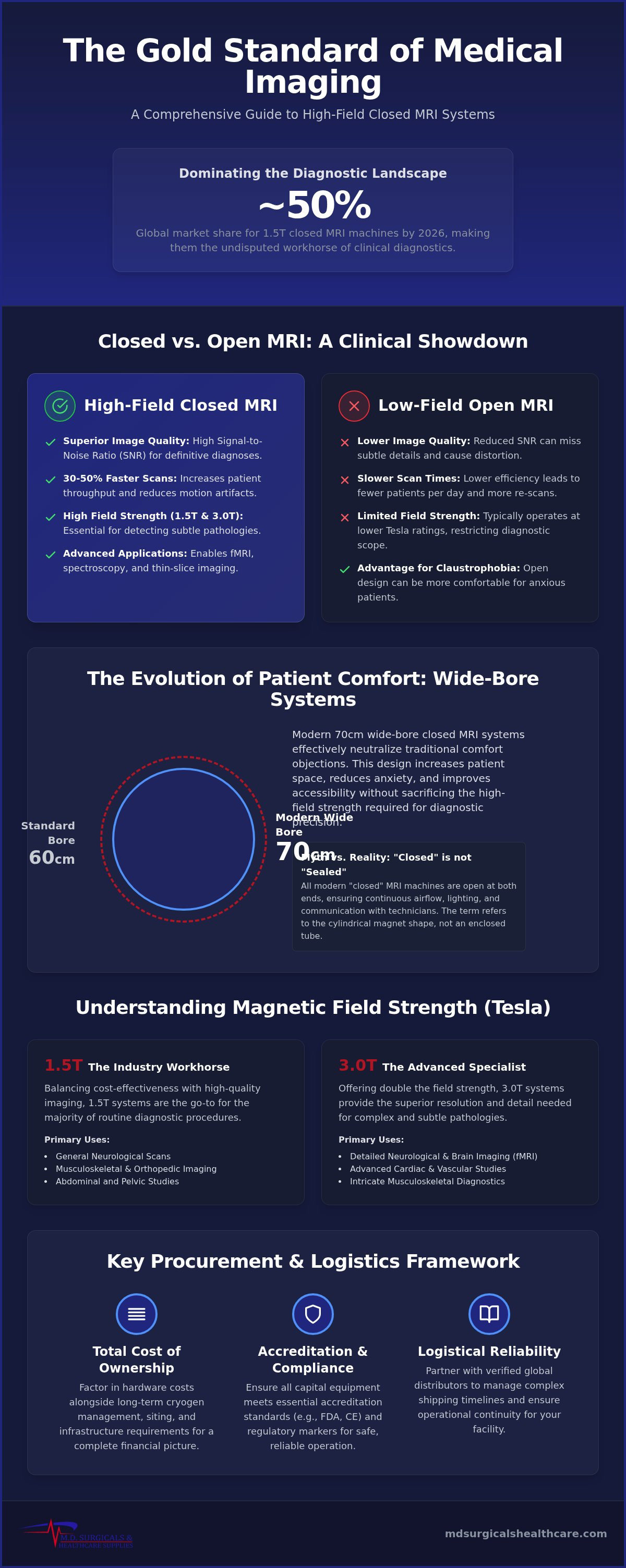
The historical barrier to adopting a closed mri machine was often patient claustrophobia. Traditional systems featured a 60cm bore, which frequently led to aborted scans and throughput bottlenecks. Modern engineering has countered this with the 70cm wide bore, which has become the institutional standard for 2026 procurement. This 10cm increase in diameter significantly reduces the feeling of confinement while allowing facilities to maintain the high-field strength required for complex diagnostics. By bridging the gap between patient experience and clinical power, wide bore systems ensure that comfort doesn't come at the expense of image resolution.
Beyond physical dimensions, these systems now integrate bariatric-friendly designs. A wider aperture accommodates patients up to 250kg, a demographic previously limited to lower-field open systems. This inclusivity allows hospitals to standardize their imaging protocols across a diverse patient population. Maintaining magnetic field homogeneity across a wider volume was a significant engineering hurdle; however, modern gradient systems now ensure that 70cm bores deliver the same precision as legacy 60cm units.
Wide Bore (70cm) vs. Standard Bore (60cm)
The transition from a 60cm standard bore to a 70cm wide bore provides a 25% increase in total bore volume. This extra headspace is often the deciding factor for anxious patients. It directly impacts departmental efficiency by lowering the rate of sedation and repeat scans. For procurement professionals, the 70cm configuration is the preferred choice for 2026. It offers better future-proofing as clinical applications continue to evolve toward larger patient profiles and more complex positioning requirements. While the wider aperture requires more sophisticated magnet design to prevent signal drop-off at the edges, the diagnostic trade-off is now negligible.
Patient-Centric Technological Enhancements
Hardware is only half of the solution. Modern systems utilize acoustic noise reduction software to lower the gradient noise that often triggers patient stress. These silent scan technologies can reduce noise levels by up to 90% in some sequences. In-bore lighting and video systems further enhance the experience, using virtual sky designs to simulate an open environment. AI-assisted reconstruction allows for even shorter bore times by accelerating data acquisition without compromising signal quality. These tools work in tandem to transform the patient experience from a clinical ordeal into a manageable, efficient procedure.
Procurement Considerations: Sourcing and Verification
Investing in a closed mri machine isn't just a capital purchase; it's a long-term logistical commitment. A comprehensive Total Cost of Ownership (TCO) analysis is essential for institutional fiscal stability. This analysis must account for consistent power consumption and the recurring expense of cryogen refills, especially for systems requiring liquid helium to maintain superconductivity. Strategic sourcing involves evaluating these operational overheads against the machine's projected diagnostic volume to ensure a sustainable return on investment. If you don't factor in these hidden costs, the initial savings on hardware can quickly vanish.
Site readiness is a critical prerequisite for any successful installation. The facility must be engineered to handle the physical and electromagnetic demands of high-field imaging. This includes reinforced flooring capable of supporting several tons and specialized RF shielding to isolate the magnet from external interference. Proactive logistical planning ensures that these structural modifications are completed before the hardware arrives, preventing delivery delays. You should consult with a supply specialist early in the process to procure accredited MRI Scanners that match your facility's specific infrastructure.
Verifying Accreditation for Diagnostic Equipment
Hardware integrity shouldn't be compromised for a lower entry price. Sourcing from licensed distributors is the only way to guarantee that a system meets international ISO and regulatory standards. Procurement professionals must perform a rigorous verification of the hardware's history, including maintenance logs and software license validity. Avoiding the risks associated with "as-is" sales from unverified third parties is crucial for maintaining institutional accreditation. A verified system comes with the assurance that all components are original and that the software is fully compliant with current diagnostic regulations.
Logistical Requirements for Global Distribution
Moving a multi-ton, sensitive magnet across international borders requires a sophisticated logistical framework. High-value medical machinery is vulnerable to shocks and temperature fluctuations during transport, making specialized handling a necessity. Managing the global supply chain involves navigating complex customs compliance and regulatory paperwork tailored to each region's healthcare laws. Dedicated supply specialists coordinate these multi-stage deliveries, ensuring that the equipment arrives in peak condition. This logistical oversight is what separates a successful clinic launch from a project plagued by regulatory bottlenecks and equipment damage.
Strategic Sourcing with M.D. Surgical & Healthcare Supplies
M.D. Surgical & Healthcare Supplies functions as a strategic logistical partner for institutions requiring unwavering stability in their supply chains. Sourcing a high-value closed mri machine requires more than a simple transaction; it demands a partner that anticipates regulatory gaps and logistical hurdles before they disrupt your clinical operations. As a licensed distributor of capital equipment, we specialize in the verification and global distribution of accredited diagnostic hardware. Our role is to provide the administrative clarity and technical precision necessary for hospitals and clinics to maintain operational continuity. We understand that in the healthcare industry, equipment downtime or procurement delays have direct consequences on patient care.
High-Value Diagnostic Equipment Sales
We maintain a comprehensive catalog of MRI Scanners from verified manufacturers, ensuring that every system meets rigorous international standards. Institutional buyers benefit from our established wholesale pricing structures, which allow for the procurement of premium hardware without the traditional retail markup. Every scanner in our inventory undergoes a meticulous verification process to confirm its accreditation and hardware history. This transparency is vital for facilities that must adhere to strict regulatory compliance while optimizing their capital expenditure. You can Buy MRI Scanners for Clinics through our secure distribution network, ensuring your facility receives only verified, high-performance technology. We prioritize hardware integrity to safeguard your diagnostic accuracy and institutional reputation.
Global Supply Continuity and Logistics
Our logistical framework is designed for global reach and rapid deployment. We leverage a vast network of supply specialists to manage the complexities of international shipping, customs documentation, and multi-stage delivery coordination. This proactive approach minimizes the risks of transit damage or regulatory impoundment, which are common pitfalls in the procurement of sensitive medical machinery. Our specialists are available to assist with technical specifications, ensuring the hardware you select perfectly aligns with your site's infrastructure. We manage the high-stakes details of global transport so your administrative team can focus on clinical outcomes. To begin the procurement process, Request a Quote for MRI Scanners and speak with a dedicated specialist about your facility's specific requirements. We prioritize security and speed to ensure your diagnostic capabilities remain uninterrupted and your facility stays at the forefront of medical technology.
Securing Your Facility’s Diagnostic Future
Selecting a high-performance closed mri machine is a strategic investment in your facility's long-term diagnostic fidelity and patient throughput. Modern 70cm wide-bore systems effectively eliminate traditional comfort barriers while maintaining the 1.5T and 3.0T field strengths required for advanced clinical mapping. As you transition from technical evaluation to acquisition, ensuring hardware accreditation and logistical stability becomes your primary operational priority. M.D. Surgical & Healthcare Supplies serves as a licensed global medical distributor, providing verified accreditation for all capital equipment and institutional wholesale pricing. Our dedicated procurement specialists manage the intricate details of international shipping and customs compliance to guarantee your hardware arrives in peak clinical condition. We anticipate supply chain gaps before they impact your operations, ensuring a seamless integration of new technology into your radiology department. Consult with our specialists for MRI Scanner procurement to secure your facility's imaging future with confidence. With the right hardware and a dependable logistical partner, you can achieve a seamless transition to superior diagnostic capabilities.
Frequently Asked Questions
Is a closed MRI machine open on both ends?
Yes, modern cylindrical bores are designed as tubes that remain open at both the head and foot. This structure allows for continuous airflow and integrated lighting during the procedure. It's a common misconception that "closed" implies a sealed environment. The term actually refers to the shape of the magnet itself, which provides the high-field environment necessary for clinical precision and image stability.
What is the standard bore size for a closed MRI machine?
The industry standard for a closed mri machine is typically 60cm for standard systems and 70cm for wide-bore configurations. While 60cm was the traditional baseline, the 70cm wide bore has become the institutional preference for 2026 procurement. This 10cm difference significantly improves patient headspace and accessibility for bariatric cases without compromising the signal-to-noise ratio or diagnostic power of the scanner.
Why is a closed MRI considered more accurate than an open MRI?
Accuracy is driven by the signal-to-noise ratio (SNR) and magnetic field homogeneity. A closed mri machine utilizes superconducting magnets in a cylindrical environment, which creates a more uniform field than open-sided magnets. This stability allows for thinner anatomical slices and higher resolution. High-field closed systems are essential for detecting minute lesions and performing advanced neurological or cardiac diagnostics that require absolute clarity.
Can claustrophobic patients use a closed MRI machine?
Yes, claustrophobic patients can often complete scans with modern wide-bore engineering and technological mitigations. A 70cm bore provides more physical clearance, while silent scan technology reduces gradient noise by up to 90% in certain sequences. In-bore entertainment systems and virtual sky lighting further alleviate anxiety. These advancements allow many patients to complete scans that would have previously required sedation or a lower-field open system.
What is the difference between a 1.5T and a 3.0T closed MRI?
The difference lies in the magnetic field strength, measured in Teslas. A 1.5T system is the clinical workhorse, suitable for most routine diagnostic procedures. A 3.0T system offers double the field strength, resulting in superior image resolution and faster acquisition times. While 1.5T is sufficient for general orthopedics, 3.0T is the preferred standard for complex neuroimaging and vascular studies in high-volume institutional facilities.
How long does a typical scan take in a closed MRI machine?
Scan times vary by sequence, but a typical session lasts between 15 and 45 minutes. Because closed systems utilize higher field strengths and more powerful gradients, they often reduce scan duration by 30% to 50% compared to open systems. AI-assisted reconstruction further accelerates this process, allowing for high-quality data acquisition in shorter windows, which directly improves daily patient throughput and departmental efficiency.
What are the installation requirements for a closed MRI system?
Installation requires a specialized environment that includes RF shielding and magnetic shielding to isolate the magnet. The facility must have reinforced flooring to support weights exceeding several tons. Logistical planning must also account for power infrastructure and cryogen venting systems. M.D. Surgical & Healthcare Supplies provides dedicated supply specialists to assist institutions with these technical specifications before coordinating international shipping and secure delivery.
How do I verify the accreditation of a used MRI machine?
Verification requires a thorough audit of the hardware's history and regulatory documentation. You should request maintenance logs, proof of ISO compliance, and valid software licenses. Sourcing through a licensed distributor like M.D. Surgical & Healthcare Supplies ensures that every system has been professionally vetted. We provide verified accreditation for all capital equipment to safeguard institutional buyers against unverified third-party sales and hardware integrity risks.


