

In a global market projected to reach $3.7 billion by 2026, the n95 respirator mask has transitioned from an emergency commodity into a precision-engineered medical instrument that requires rigorous technical oversight. Procurement professionals now face the dual challenge of maintaining supply chain stability while filtering through the persistent noise of counterfeit products and industrial-grade alternatives. You likely understand that the distinction between a standard NIOSH-approved respirator and an FDA-cleared surgical N95 is often the difference between clinical compliance and operational risk.
This technical guide empowers healthcare administrators and procurement specialists to master the latest specifications and regulatory requirements to ensure consistent, clinical-grade respiratory protection. We'll examine the 2026 OSHA updates regarding medical evaluations, detail the critical differences between various 3M series models, and provide a methodical roadmap for securing verified, accredited stock at scale. By focusing on quality assurance and logistical transparency, you can navigate the complexities of the current respiratory protection landscape with institutional confidence and administrative clarity.
Key Takeaways
- Understand the electrostatically charged filtration science and melt-blown fabric layers that distinguish a true respirator from a standard surgical mask.
- Navigate the 2026 NIOSH and FDA regulatory frameworks to ensure your selected n95 respirator mask meets the specific requirements for your clinical or industrial environment.
- Evaluate the technical performance differences between the 3M 8210 and the surgical-grade 3M 1860 to correctly match equipment to specific procedural fluid-resistance needs.
- Implement rigorous verification protocols, including TC number validation and label inspection, to eliminate the risk of counterfeit products in your institutional supply chain.
- Align your facility with updated OSHA 1910.134 standards by prioritizing fit-testing protocols that guarantee a functional seal and maximum staff safety.
Understanding the N95 Respirator: Mechanism and Filtration Science
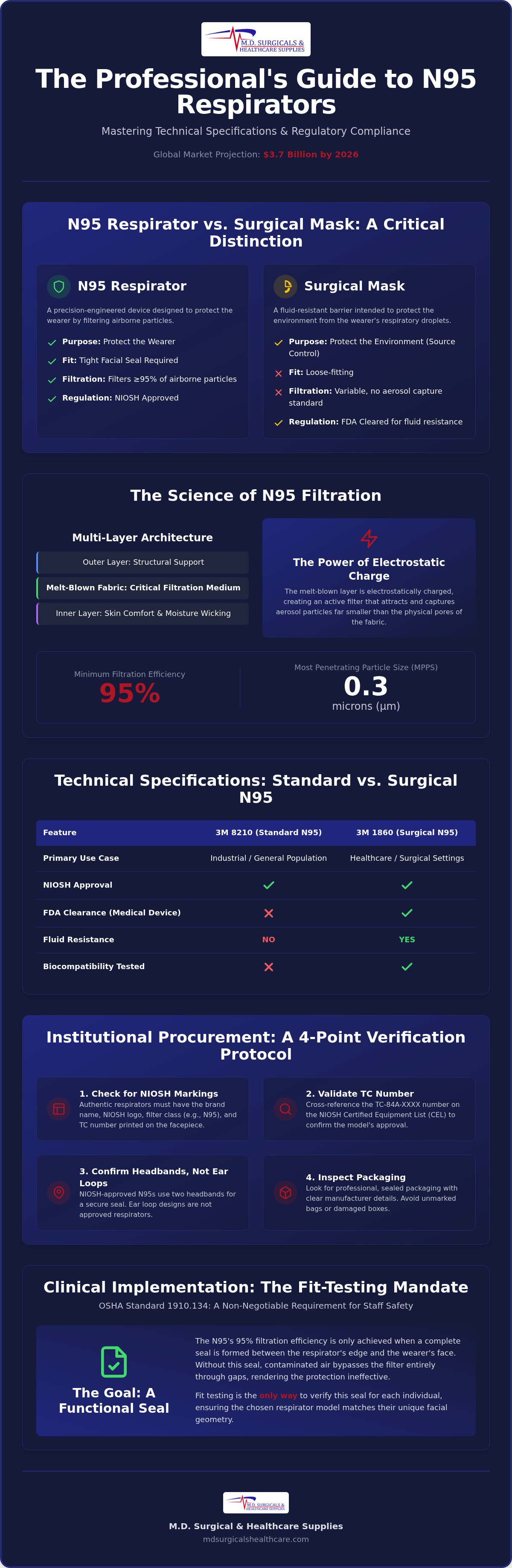
Terminology matters in clinical procurement. An N95 is not a mask. It's a respirator, a classification that carries specific engineering requirements, regulatory obligations, and performance standards that a standard surgical mask cannot meet. The "N" designates resistance to non-oil-based particulates, and the "95" confirms a minimum filtration efficiency of 95% against the most penetrating particle size under controlled NIOSH testing conditions. For a detailed N95 respirator overview covering its regulatory history and classification standards, the foundational literature is clear: this device is purpose-engineered for respiratory protection, not source control.
The filtration architecture relies on multiple non-woven polypropylene layers, with the melt-blown fabric layer functioning as the critical filtration medium. During melt-blowing, polypropylene is extruded through fine nozzles and charged electrostatically, creating a dense, fibrous matrix. That electrostatic charge is what separates an n95 respirator mask from any mechanical filter. Particles don't simply have to be larger than the pores to be captured; they're actively attracted to the charged fibers. This means the filtration mechanism captures aerosols far smaller than the physical pore size would suggest possible.
N95 vs. Surgical Masks: A Performance Comparison
Surgical masks are fluid-resistant barriers designed primarily to protect the environment from the wearer, reducing droplet dispersal. They offer variable filtration efficiency with no standardized aerosol capture requirement. An N95, by contrast, mandates a minimum 95% particulate filtration efficiency and, critically, requires a tight-fitting facepiece that creates a functional facial seal. Without that seal, inward leakage bypasses filtration entirely. This is why fit-testing under OSHA 1910.134 is non-negotiable: the respirator's engineering only performs as specified when the seal is verified against the individual wearer's facial geometry.
The Physics of 0.3 Micron Particles
The Most Penetrating Particle Size (MPPS) is 0.3 microns, the aerosol diameter at which neither interception nor diffusion mechanisms operate at peak efficiency, making it the benchmark NIOSH uses to establish the minimum filtration threshold. Larger particles are captured through direct interception and inertial impaction as they can't navigate around fibers. Smaller particles, moving erratically via Brownian motion, are captured through diffusion as their unpredictable paths increase fiber contact probability. The electrostatic charge reinforces both mechanisms across the full particle size spectrum, which is why a properly manufactured n95 respirator mask consistently exceeds its rated 95% efficiency in real-world aerosol environments.
Regulatory Frameworks: NIOSH and FDA Standards in 2026
NIOSH governs the technical approval of every n95 respirator mask sold in the United States. It's not a generic quality mark. It's a rigorous certification process under 42 CFR Part 84. NIOSH categorizes respirators based on oil resistance. N-series masks are not resistant to oil. R-series are somewhat resistant. P-series are oil-proof. For most clinical and industrial settings, the N95 remains the standard because oil-based aerosols are rarely the primary concern in these environments.
Global procurement often involves navigating international standards. You'll frequently encounter FFP2 (European EN 149) and KN95 (Chinese GB 2626) designations. While these standards share similar filtration benchmarks, they differ in testing protocols for breathability and fit. For U.S. institutional compliance, NIOSH approval is the mandatory baseline. To ensure your facility maintains a verified supply of accredited respirators, always prioritize NIOSH-certified models over international alternatives that lack domestic clearance.
NIOSH Approval Requirements and Labeling
Every authentic unit must display specific markings. You'll find the brand name, the NIOSH logo, and the filter class clearly printed on the facepiece. The most critical element is the TC (Testing and Certification) number. This unique identifier allows procurement officers to verify the product against the NIOSH Certified Equipment List. NIOSH also monitors breathability by measuring inhalation and exhalation resistance. If a mask is too difficult to breathe through, it fails certification regardless of its filtration efficiency.
Surgical N95 Respirators for Clinical Environments
An N95 becomes a "Surgical N95" only after receiving FDA 510(k) clearance. This dual certification is essential for operating rooms and high-risk clinical zones. The FDA evaluates these devices based on FDA standards for N95 respirators, which include ASTM F1862 fluid resistance testing. This test simulates high-pressure splashes of synthetic blood to ensure the wearer is protected during invasive procedures.
Beyond fluid resistance, surgical models must meet strict biocompatibility and flammability requirements. These respirators don't just filter air. They act as a physical shield against liquid contaminants. In 2026, the distinction between a standard industrial n95 respirator mask and a surgical-grade version remains a critical procurement decision for healthcare logistical chains. Identifying the correct regulatory clearance ensures that staff safety matches the specific procedural risks of the clinical setting.
Technical Specifications: Comparing the 3M 8210 and 1860 Series
Selecting an n95 respirator mask requires a granular understanding of physical architecture and intended environment. While consumer-grade masks often utilize ear loops for convenience, NIOSH only grants approval to head-strap designs. This is a technical necessity. Head-straps provide the consistent tension required to maintain a functional facial seal during active clinical duties, preventing the inward leakage that occurs when ear loops lose elasticity. Within the 3M catalog, the 8210 and 1860 series represent the two primary pillars of institutional protection, each engineered for distinct risk profiles.
The 3M 8210: Versatility in Healthcare
The 3M 8210 is the foundational particulate respirator for both industrial and general healthcare applications. It utilizes advanced electret media, which reduces breathing resistance while maintaining a 95% filtration threshold. Its classic cup-style shape provides a spacious interior, which helps reduce heat buildup during long shifts in non-surgical environments. For laboratory technicians or staff in general patient care, the 8210 offers a pragmatic balance of protection and durability. You can verify its standing among other NIOSH-approved N95 respirators to ensure it meets your facility's baseline safety requirements for non-fluid-intensive zones.
The 3M 1860 and 1860S: Surgical Precision
Transitioning to the sterile field requires the 3M 1860 series. Unlike the 8210, the 1860 is cleared by the FDA for use as a surgical mask, meaning it provides high-level fluid resistance against synthetic blood splashes. This is a critical specification for operating rooms where aerosol-generating procedures are frequent. The physical design is reinforced to resist collapse in high-humidity environments, a common challenge during lengthy surgical cases. Sizing is equally critical for institutional safety; the 1860S variant is specifically designed for smaller facial profiles, ensuring that staff with narrower features don't suffer from seal gaps that the standard 1860 might create.
Procurement officers must distinguish between these models based on fluid exposure risk rather than filtration alone. Both models provide identical protection against airborne pathogens, but only the 1860 series is tested for ASTM F1862 fluid resistance. If your facility requires the Aura series, which features a flat-fold design, you gain the advantage of portability and improved peripheral vision, though the cup-style 8210 remains the preferred choice for heavy-duty industrial use. Verifying the FDA clearance of the 1860 series is a mandatory step for any sterile environment procurement protocol to ensure full clinical compliance.
Institutional Procurement: Verifying Authenticity and Supply Continuity
Global supply chains for any n95 respirator mask remain vulnerable to sophisticated counterfeit operations. Securing a reliable supply requires moving beyond simple price-point analysis. It's about technical verification. Fakes often feature subtle red flags like misspelled branding or incorrect font on the facepiece. More critically, they lack valid TC numbers that match the NIOSH database. A licensed medical distributor acts as your primary defense. They ensure every unit in your facility is part of a verified, traceable lineage from the manufacturer.
Bulk Procurement Strategies for 2026
Effective procurement involves balancing Just-in-Time efficiency with Just-in-Case resilience. While lean inventory reduces overhead, it leaves facilities exposed during regional shortages. Strategic stockpiling is now a standard requirement for institutional safety. Working with dedicated supply specialists allows you to anticipate market shifts before they impact your front-line operations.
- Evaluate wholesale case pricing and volume-based tiers to optimize budget allocation across high-volume departments.
- Implement strict lot number tracking to ensure a first-in, first-out (FIFO) rotation and maintain inventory transparency.
- Monitor shelf-life data consistently; most N95s carry a five-year expiration from the date of manufacture.
If you need to secure bulk N95 inventory, partnering with a licensed distributor provides the logistical stability necessary for clinical continuity. This proactive approach prevents the administrative delays caused by last-minute sourcing from unverified vendors.
Verification Protocols for New Vendors
Don't rely on digital catalogs alone. Request physical copies of NIOSH approval certificates and FDA 510(k) documentation for surgical models. Verify the distributor's medical equipment licenses to ensure they are authorized to handle clinical-grade PPE. You can verify a respirator's authenticity by cross-referencing the TC number printed on the mask with the official NIOSH Certified Equipment List to confirm it matches the specific manufacturer and model. Identifying an authentic n95 respirator mask is the final line of defense for staff safety and regulatory compliance.
Clinical Implementation: Fit Testing and Safety Protocols
Legal compliance in healthcare facilities centers on OSHA 1910.134, which requires a formal, written respiratory protection program. Procurement is only the first step. The actual safety of your staff depends on the rigorous application of these standards. A respirator only functions as intended when it creates an airtight seal against the wearer's face. Without this seal, air takes the path of least resistance through gaps, bypassing the electrostatically charged filter media entirely. An n95 respirator mask that hasn't been properly fit-tested offers a false sense of security that can lead to significant clinical exposure.
Facilities must choose between qualitative and quantitative fit testing based on their specific risk environment. Qualitative testing is a pass/fail method that relies on the wearer's sensory detection of a test agent. Quantitative testing uses specialized instrumentation to measure the actual concentration of particles inside the mask compared to the ambient air. While qualitative testing is common for standard N95 use, quantitative methods provide an objective "fit factor" that offers a higher degree of certainty for high-risk surgical environments.
The Fit Testing Process
Staff safety begins with a structured three-step protocol designed to verify both physical tolerance and equipment performance. This process ensures that the selected model matches the individual's facial geometry.
- Step 1: Medical Evaluation. While 2026 OSHA updates have proposed removing the mandatory medical evaluation for filtering facepiece respirators, many institutions maintain a baseline questionnaire to ensure staff can safely tolerate the physical demands of respirator use.
- Step 2: Sensitivity Testing. The administrator verifies the wearer can detect the test agent, such as Bitrex or Saccharin, at low concentrations to ensure the validity of the subsequent pass/fail assessment.
- Step 3: The 7-Exercise Protocol. The wearer performs specific movements, including deep breathing, head rotation, and talking, to simulate real-world clinical activity while the seal integrity is monitored for any signs of leakage.
Respirator Maintenance and Reuse Protocols
Current 2026 guidelines emphasize extended wear over limited reuse to maintain the highest hygiene standards. Extended wear involves keeping the same respirator on for the duration of a single shift while treating multiple patients with the same diagnosis. If reuse is necessary due to supply constraints, the mask must be meticulously inspected for physical integrity, strap elasticity, and structural collapse. It's critical to discard any respirator that is visibly soiled or becomes difficult to breathe through.
Storage is a critical factor in maintaining filtration efficiency. Never store respirators in airtight plastic containers. Moisture trapped inside can lead to microbial growth and degrade the electrostatic charge of the melt-blown polypropylene fibers. Instead, utilize breathable containers like clean paper bags, which allow moisture to evaporate while protecting the mask from surface contaminants. For comprehensive guidance on building a resilient supply chain and selecting the right equipment, you can consult with M.D. Surgical & Healthcare Supplies specialists for institutional PPE planning to ensure your facility remains compliant and fully protected.
Securing the Future of Institutional Respiratory Safety
Maintaining a clinical-grade respiratory protection program requires more than just high-volume purchasing. It demands a technical understanding of how an n95 respirator mask functions, from its electrostatic filtration to the necessity of a verified facial seal under OSHA standards. By prioritizing NIOSH-approved models and implementing rigorous vendor verification protocols, you ensure your facility is prepared for both routine patient care and high-risk aerosol-generating procedures.
M.D. Surgical & Healthcare Supplies acts as the logistical backbone for global healthcare providers. As a licensed distributor with a verified supply chain, we offer direct access to specialists who understand the nuances of institutional procurement. Request a wholesale quote for bulk N95 respirators to stabilize your supply chain with accredited PPE. Protecting your staff is a high-stakes priority. With a technical partner, you'll achieve administrative clarity and unwavering safety.
Frequently Asked Questions
What is the difference between an N95 and a KN95 mask?
N95 respirators are certified by NIOSH under United States standards, while KN95 masks meet Chinese regulatory requirements. The primary technical difference lies in the attachment method and breathability testing protocols. NIOSH only approves head-strap designs because they provide the tension necessary for a consistent facial seal. KN95s often utilize ear loops, which are prone to leakage. For high-risk clinical environments, the N95 remains the mandatory choice for institutional compliance.
How long can a healthcare worker safely wear a single N95 respirator?
Healthcare professionals can typically wear a single respirator for up to 8 to 12 hours of continuous or intermittent use. However, the device must be discarded immediately if it becomes visibly soiled, damp, or if breathing resistance increases significantly. The structural integrity of the filter media and the elasticity of the head-straps are the primary limiting factors. In high-aerosol environments, shift-based disposal is often the safest clinical protocol to prevent self-contamination.
Is fit testing legally required for all employees using N95s?
Yes, annual fit testing is a legal mandate under OSHA 29 CFR 1910.134 for any employee required to wear a respirator. This requirement applies to every specific make, model, and size of n95 respirator mask used in the workplace. Even if a staff member has used N95s previously, they must be re-tested whenever a new brand or model is introduced to the facility's inventory to ensure the seal remains functional.
Can N95 respirators be sanitized and reused in 2026?
In 2026, the clinical consensus prioritizes single-use or extended wear over sanitization and reuse. While emergency protocols existed in the past, modern supply chain stability has rendered decontamination methods like UVGI or vaporized hydrogen peroxide unnecessary. These processes can degrade the electrostatic charge of the melt-blown polypropylene fibers, compromising filtration efficiency. Facilities should maintain a robust inventory of fresh units rather than attempting to reprocess used equipment.
What does the "TC" number on an N95 mask signify?
The "TC" stands for Testing and Certification. This alphanumeric code is a unique identifier issued by NIOSH that confirms the respirator has passed specific performance evaluations. It's a critical tool for procurement officers to verify the legitimacy of their stock. By entering this number into the NIOSH Certified Equipment List, you can confirm that the manufacturer and model are officially recognized as meeting federal safety standards.
Why do some N95 respirators have valves, and are they allowed in hospitals?
Exhalation valves reduce heat and moisture buildup inside the mask, improving comfort during physically demanding tasks. However, they are generally prohibited in sterile environments or for source control because they allow unfiltered air to escape. In a hospital setting, a valved n95 respirator mask would protect the wearer but could potentially expose patients to the wearer's respiratory droplets. Standard non-valved models are the preferred choice for clinical safety.
How do I verify if an N95 mask is NIOSH-approved?
Verification begins with inspecting the physical markings on the facepiece. An authentic unit must display the NIOSH logo, the filter class (N95), the model number, and the TC number. If any of these elements are missing or misspelled, the product is likely counterfeit. For absolute certainty, cross-reference the manufacturer and model number with the CDC's official database of approved particulate filtering facepiece respirators to ensure the accreditation is current.
What is the shelf life of a bulk-purchased 3M 1860 respirator?
The 3M 1860 Health Care Particulate Respirator typically has a shelf life of five years from the date of manufacture when stored in its original packaging. This duration is dependent on maintaining optimal storage conditions, specifically temperatures between -4°F and 86°F with humidity below 80%. Procurement managers should regularly inspect lot numbers and manufacture dates to ensure that stockpiled inventory remains within its effective performance window for clinical use.

