

In 2026, procurement is no longer about surviving a shortage; it's about mastering the logistics of institutional stability. You likely recognize that securing bulk n95 respirators for hospitals requires more than just a purchase order. It demands a verified, compliant supply chain that can withstand global volatility and the persistent threat of counterfeit products. Managing complex international customs for large medical shipments is a burden your facility shouldn't carry alone. We understand that clinical precision must extend beyond the operating room and into your procurement strategy.
This guide provides a professional framework for institutional N95 procurement, focusing on NIOSH compliance, volume logistics, and the mitigation of lead-time uncertainty. You'll gain a clear understanding of how to secure a stable N95 supply for 12 months or more. We'll examine the latest 2026 FDA guidance, the shift toward risk-based PPE protocols, and the precise logistics required to move high-volume shipments from global warehouses directly to your hospital loading dock. By the end of this article, you'll have the roadmap needed to ensure operational continuity through rigorous verification and strategic distribution.
Key Takeaways
- Identify the critical regulatory distinctions between standard surgical masks and NIOSH-certified respirators required for high-risk clinical environments.
- Establish a rigorous verification process for manufacturer accreditation to eliminate counterfeit risks within your institutional supply chain.
- Optimize logistical efficiency by coordinating LTL or FTL freight based on precise palletization and case-count specifications.
- Secure price stability and inventory predictability for bulk n95 respirators for hospitals by utilizing Blanket Purchase Orders and wholesale case-range structures.
- Transition from reactive purchasing to a strategic partnership model that ensures long-term operational continuity through global distribution networks.
What are Bulk N95 Respirators for Hospital Use?
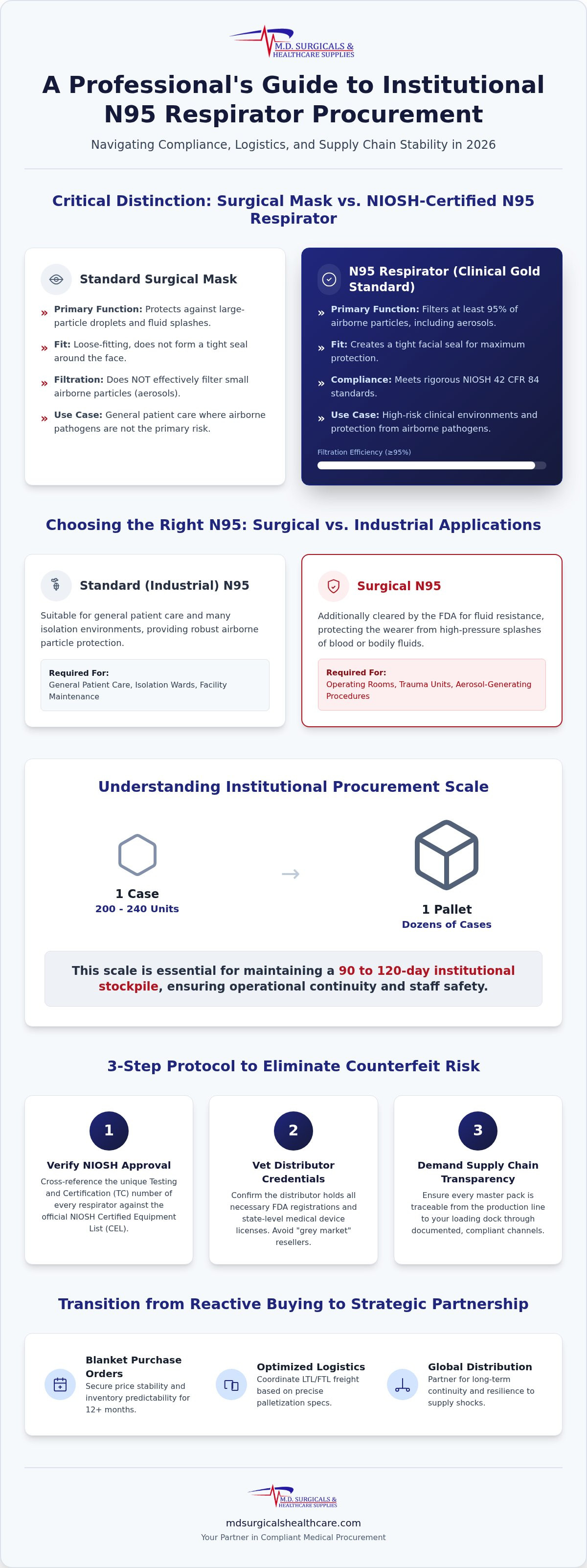
An N95 respirator is a specialized particulate-filtering facepiece that meets the rigorous 42 CFR 84 standards established by the National Institute for Occupational Safety and Health (NIOSH). N95 respirators are the clinical gold standard for airborne pathogen protection in 2026. Unlike standard surgical masks, which primarily protect against large-particle droplets and fluid splashes, these respirators provide a tight facial seal and filter at least 95% of airborne particles, including aerosols. For healthcare administrators, procurement involves more than individual units; it centers on securing bulk n95 respirators for hospitals through structured, high-volume logistics.
In a professional healthcare setting, "bulk" refers to procurement at the case, master pack, or pallet level. A standard case typically contains 200 to 240 units, while a pallet can hold dozens of cases depending on the manufacturer's specific packaging configuration. This scale is essential for maintaining a 90-day or 120-day stockpile, ensuring that frontline staff never face the "crisis capacity" scenarios seen in previous years. Efficient procurement at this volume requires a distributor capable of managing palletized freight and verifying the authenticity of every master pack before it reaches the hospital loading dock.
NIOSH Approval and Regulatory Compliance
Every authentic N95 respirator carries a unique Testing and Certification (TC) number. This number allows procurement officers to verify the hardware against the NIOSH Certified Equipment List, providing a critical layer of defense against counterfeit products. The CDC and NIOSH work in tandem to oversee these standards, ensuring that every mask provides the promised filtration efficiency. While international standards like KN95 or FFP2 offer similar filtration, they often lack the fluid resistance or fit-test reliability required by specific hospital bylaws. Relying on NIOSH-verified products ensures that your facility remains compliant with OSHA respiratory protection programs and internal safety mandates.
Surgical vs. Industrial N95s
It's vital for procurement teams to distinguish between standard N95s and "Surgical N95s." Surgical versions are cleared by the FDA specifically for use in the operating room. These respirators must meet ASTM F1862 standards for fluid resistance, protecting the wearer from high-pressure streams of blood or other infectious bodily fluids. While industrial N95s are suitable for general patient care and many isolation environments, surgical departments and trauma units require this added fluid barrier. Choosing the correct protection level depends on the specific aerosol-generating procedures performed within each department. Strategic inventory management involves balancing these two types to ensure maximum safety and cost-efficiency across the entire institution.
Evaluating Wholesale N95 Manufacturers and Distributors
Selecting a distribution partner for bulk n95 respirators for hospitals in 2026 requires a shift in perspective. You aren't just buying a product; you're vetting a logistical backbone capable of sustaining your facility's operational continuity. A qualified distributor must demonstrate a clear history of handling million-unit orders without the lead-time volatility that plagues smaller resellers. This requires a sophisticated understanding of international freight and the capacity to absorb supply shocks. Transparency in the supply chain is the only way to ensure that your institution isn't exposed to the liability risks associated with unverified hardware.
Distributor Licensing and Accreditation
Institutional procurement officers must verify that a distributor holds the necessary FDA registrations and state-level medical device licenses. These credentials aren't optional. They're the baseline for institutional safety. In 2026, global sourcing often involves navigating standards set by the WHO alongside domestic requirements. Relying on "grey market" resellers who lack these accreditations introduces unacceptable risks to hospital liability and patient safety. Authentic FDA-regulated surgical N95 respirators must be traced from the production line to your loading dock. Working with a licensed medical equipment distributor ensures that every case in your warehouse is fully documented and legally compliant.
Manufacturer Reliability Metrics
Evaluating a manufacturer involves analyzing more than their NIOSH TC number. You need to assess historical fill rates and current production lead times to maintain a steady flow of bulk n95 respirators for hospitals. Established brands like 3M or Harley have proven track records, but relying on a single manufacturer can create a single point of failure in your supply chain. Strategic procurement teams often utilize multi-brand sourcing to build redundancy. This approach allows for flexibility if one region experiences shipping delays or raw material shortages. By diversifying your manufacturer portfolio, you protect your hospital from the sudden inventory gaps that can compromise frontline safety protocols. A dependable distributor will provide the transparency needed to monitor these metrics in real-time.
Logistics of Bulk Hospital PPE Procurement
Managing the movement of bulk n95 respirators for hospitals requires a shift from retail delivery expectations to industrial freight coordination. When dealing with orders exceeding 100,000 units, procurement officers must account for precise palletization. A typical master case contains 240 respirators. A standard 48x40-inch pallet usually holds 30 to 36 cases. This means a single 100,000-unit order occupies approximately 12 to 14 pallets. Understanding these dimensions is critical for calculating warehouse footprint and determining whether to utilize Less Than Truckload (LTL) or Full Truckload (FTL) shipping. FTL is generally preferred for institutional stability as it reduces the number of touchpoints, decreasing the risk of box damage or inventory loss during transit.
Navigating international customs is the most complex phase of global medical supply distribution. Large-scale shipments must clear rigorous inspections to ensure the hardware matches the provided NIOSH documentation. Lead times for 100,000+ unit orders often range from four to eight weeks, depending on the manufacturer's current production queue and the chosen freight method. Proactive administrators often reference CDC guidelines on optimizing the supply of N95 respirators to balance current burn rates with these logistical timelines. This foresight prevents the "crisis capacity" strategies that compromise safety when shipments are delayed at international borders.
Freight and Global Distribution
Optimizing shipping costs for high-volume PPE requires a strategic approach to lane management and carrier selection. Supply chain visibility is no longer a luxury; it's a requirement for operational security. Real-time tracking from the factory floor to the hospital loading dock allows facilities to adjust their internal distribution schedules based on verified arrival data. Additionally, institutional orders must include comprehensive insurance and liability coverage for international transit. This protects the hospital's capital investment against maritime risks or port congestion. A professional distributor manages these variables, ensuring that the administrative burden of customs clearance and freight insurance doesn't fall on clinical staff.
Storage and Shelf-Life Considerations
Warehouse management for multi-pallet respirator orders involves more than just floor space. N95 respirators have specific storage environment requirements to maintain the integrity of the electrostatic filter media and the elasticity of the headbands. High humidity or extreme temperatures can degrade the materials before their stated expiration date. Implementing a First-In, First-Out (FIFO) inventory strategy is essential for institutional compliance. This practice ensures that older stock is deployed first, preventing the accumulation of expired hardware that could fail a fit test or provide inadequate protection. Effective storage planning ensures that your bulk investment remains a viable clinical asset for its entire five-year shelf life.
Volume Pricing and Blanket Purchase Orders (BPO)
Fiscal predictability is just as vital as logistical stability when managing bulk n95 respirators for hospitals. While spot-market purchases can address immediate gaps, they leave your budget vulnerable to price spikes and inventory competition. Professional procurement in 2026 relies on wholesale case ranges where the per-unit cost decreases as your volume commitment increases. This tiered structure allows administrators to forecast annual expenditures with precision. By moving away from reactive buying, your institution gains the leverage needed to secure priority allocation from global manufacturing lines.
Administrative overhead often becomes a hidden cost in large-scale medical supply chains. Processing hundreds of individual purchase orders throughout the fiscal year drains resources and introduces opportunities for clerical error. A Blanket Purchase Order (BPO) solves this by establishing a single, long-term contract for a set quantity of bulk n95 respirators for hospitals, delivered in scheduled increments. This recurring supply model ensures that your loading dock receives a steady flow of hardware without requiring a new round of negotiations for every shipment.
Strategic Price Locking
Market volatility is a persistent risk in the healthcare industry. Long-term agreements mitigate this by locking in pricing for 12 to 24 months, shielding your facility from the fluctuations of raw material costs or shipping surcharges. Unlike spot-buy models that prioritize immediate availability at a premium, contract pricing offers a stable baseline. These agreements often include escalation clauses or volume-based discounts that reward institutional loyalty. This proactive approach ensures that your 2026 budget remains intact regardless of external market pressures. You're no longer just a customer; you're a strategic partner with a guaranteed seat at the table.
Customized Procurement Solutions
Every hospital network has unique budgetary constraints and facility requirements. Working with dedicated supply specialists allows you to tailor your procurement strategy to your specific needs. This might include consolidated billing for multi-facility networks, where a single invoice covers deliveries to several different campuses. Flexible payment terms and customized delivery schedules further align the supply chain with your clinical operations. To begin building a more resilient and cost-effective supply chain, you can request a consultative quote for institutional N95 orders today. This dialogue ensures that your procurement strategy is as precise as the medical care you provide.
Securing Your Hospital Supply with M.D. Surgical & Healthcare
M.D. Surgical & Healthcare Supplies functions as the logistical backbone for institutions that cannot afford supply chain interruptions. We don't just ship boxes; we manage the complex intersection of regulatory compliance and global distribution. As a licensed medical and surgical equipment distributor, our priority is the integrity of your frontline protection. Every order of bulk n95 respirators for hospitals undergoes a meticulous verification process. We confirm NIOSH TC numbers and manufacturer accreditation before any hardware leaves our global network. This proactive vigilance ensures that your hospital receives only authentic, high-performance respirators that meet the stringent 2026 safety standards.
Our logistical reach extends to healthcare facilities worldwide. We understand that clinical operations depend on more than just masks. By offering a comprehensive portfolio that includes MRI scanners, CT scanners, and patient monitors, we demonstrate the high-capacity infrastructure required to support entire hospital systems. This breadth of service reinforces our position as a strategic partner focused on long-term operational continuity rather than short-term transactions. Our team provides the global competence needed to navigate international freight regulations and customs clearance with administrative ease.
The M.D. Surgical Distribution Advantage
Sourcing from accredited manufacturers is the foundation of our distribution model. We maintain direct relationships with verified producers to ensure constant NIOSH compliance and fast delivery options. Our supply continuity guarantees are backed by a global sourcing network that anticipates regional disruptions before they impact your inventory. This allows us to provide integrated solutions that go beyond PPE. Whether you're upgrading your diagnostic imaging suite with new ultrasound systems or replenishing your stock of bulk n95 respirators for hospitals, our team provides the technical precision your facility requires. We treat every order with the clinical seriousness it deserves.
Initiating a Bulk Quote Request
The process for securing institutional volume pricing is designed for administrative efficiency. It begins with a consultative dialogue to understand your specific burn rates and 2026 inventory targets. A dedicated supply specialist will work with your procurement team to structure a quote that reflects your annual volume commitments and budgetary constraints. This personalized support ensures that your pricing, delivery schedules, and logistics are optimized for your facility's unique needs. You can Request a Bulk N95 Quote for Your Hospital to begin the planning process. Our specialists are ready to provide the transparency and logistical certainty your institution needs to thrive in the coming year.
Securing Institutional Stability for 2026 and Beyond
Securing bulk n95 respirators for hospitals in 2026 requires moving beyond reactive purchasing and into a model of strategic, long-term stability. You now have the professional framework to evaluate distributor accreditation, manage complex palletized freight logistics, and utilize Blanket Purchase Orders for fiscal predictability. Implementing these institutional standards ensures that your frontline staff remains protected by verified, NIOSH-compliant hardware regardless of market fluctuations. Transitioning to a consultative procurement model protects your budget and your patients simultaneously.
M.D. Surgical & Healthcare Supplies provides the institutional reliability necessary to sustain these high-stakes operations. As a licensed medical distributor with verified NIOSH sourcing and global logistical expertise, we anticipate supply chain gaps before they impact your facility. We don't just deliver equipment; we provide the administrative clarity and logistical backbone required for unwavering operational continuity. Secure Your Hospital's N95 Supply with M.D. Surgical today and establish a resilient procurement roadmap for the coming year. Your facility's readiness is our priority.
Frequently Asked Questions
How do I verify if a bulk N95 shipment is NIOSH-approved?
Check the Testing and Certification (TC) number printed directly on the respirator or its packaging. You can verify this unique identifier against the NIOSH Certified Equipment List (CEL). Authentic respirators must also feature the NIOSH name or logo, the filter class (N95), and the manufacturer's name. Our verification process confirms these details before shipment to eliminate counterfeit risks. This ensures your facility remains compliant with OSHA respiratory protection standards.
What is the typical lead time for a hospital-sized bulk N95 order in 2026?
Lead times for large-scale bulk n95 respirators for hospitals generally range from four to eight weeks. This duration depends on current production queue status and the selected freight method, such as air or ocean transport. Orders exceeding 100,000 units require coordination with manufacturing lines to ensure priority allocation. We recommend initiating procurement at least 60 days before your current stockpile reaches critical levels to account for international customs clearance.
Can N95 respirators be shipped internationally to any healthcare facility?
Yes, we provide global shipping and sourcing capabilities for healthcare facilities worldwide. However, international transit requires strict adherence to regional medical device regulations and customs documentation. Each shipment must clear rigorous inspections to verify that the hardware matches the provided NIOSH documentation. Our logistics team manages these variables, ensuring that your delivery reaches the hospital loading dock without administrative delays or unexpected port congestion during transit.
What are the standard pallet quantities for N95 respirators?
A standard 48x40-inch pallet typically holds between 30 and 36 cases of respirators. Since a master case usually contains 240 units, a single pallet accommodates roughly 7,200 to 8,640 respirators. Understanding these dimensions is essential for calculating warehouse footprint and determining if your facility requires Less Than Truckload (LTL) or Full Truckload (FTL) freight. We provide precise palletization data during the quote process to assist with your storage planning.
Is there a difference between industrial N95s and surgical N95s for hospitals?
Surgical N95 respirators are cleared by the FDA and must meet ASTM F1862 standards for fluid resistance. This makes them suitable for operating rooms where exposure to high-pressure blood or infectious fluids is likely. Industrial N95s provide identical filtration efficiency but lack the fluid-resistant outer layer. Most hospitals stock both types, deploying surgical versions in trauma units and industrial versions for general patient care and airborne isolation environments to optimize costs.
How does a Blanket Purchase Order (BPO) work for medical supplies?
A Blanket Purchase Order establishes a single, long-term contract for a specific quantity of supplies delivered in scheduled increments. This model locks in pricing for 12 to 24 months, shielding your institution from market volatility and raw material surcharges. It reduces administrative overhead by eliminating the need for recurring negotiations. Your facility receives a steady flow of bulk n95 respirators for hospitals while maintaining fiscal predictability throughout the entire fiscal year.
What certifications should a licensed medical distributor hold?
A legitimate distributor must hold valid FDA registration and state-level medical device licenses for every region they serve. These accreditations ensure that the provider follows strict protocols for sourcing, storage, and distribution. In 2026, global distributors should also demonstrate alignment with WHO standards for international medical supply chains. We maintain these rigorous credentials to provide the logistical backbone and clinical precision required by institutional healthcare buyers and hospital networks.
Are volume discounts available for multi-facility hospital groups?
Yes, we offer competitive wholesale case range pricing structures tailored to the needs of multi-facility hospital networks. Volume discounts are negotiated based on total annual commitments rather than individual campus orders. This approach allows for consolidated billing and synchronized delivery schedules across several locations. Our dedicated supply specialists work with your procurement team to optimize these tiered pricing models, ensuring maximum cost-efficiency for large-scale institutional orders and long-term supply continuity.

