

A diagnostic facility's operational continuity often hinges on a single procurement decision that extends far beyond the initial hardware invoice. You're likely balancing the urgent need for high-slice resolution with the reality of a rigid institutional budget. It's common to feel uncertain when hidden installation costs or complex shielding requirements influence a ct scanner price late in the acquisition process. Verifying the integrity of refurbished units and managing the logistics of international shipping for heavy medical hardware only adds to this administrative burden.
This 2026 guide provides the technical and logistical clarity required to evaluate your investment through the lens of total cost of ownership. We'll establish a framework for understanding how slice counts, X-ray tube longevity, and cooling systems drive long-term value. You'll gain a clear view of the performance tiers currently available, from entry-level 16-slice units to the latest photon-counting configurations. Finally, we'll examine the rigorous verification protocols and global distribution strategies that ensure your facility receives accredited, clinical-grade equipment without the risk of supply chain gaps.
Key Takeaways
- Identify the correlation between slice count and diagnostic capability to determine the appropriate ct scanner price for your facility's volume.
- Analyze how technical drivers, including X-ray tube configuration and AI-integrated software, influence image resolution and procurement costs.
- Compare the long-term ROI of new versus refurbished units while maintaining strict adherence to ISO and FDA verification criteria.
- Calculate the total cost of ownership by incorporating site preparation requirements like HVAC and specialized lead shielding into your budget.
- Establish a strategic partnership for operational continuity by leveraging global sourcing and accredited hardware verification for capital equipment.
CT Scanner Price Tiers: Understanding Cost by Slice Count
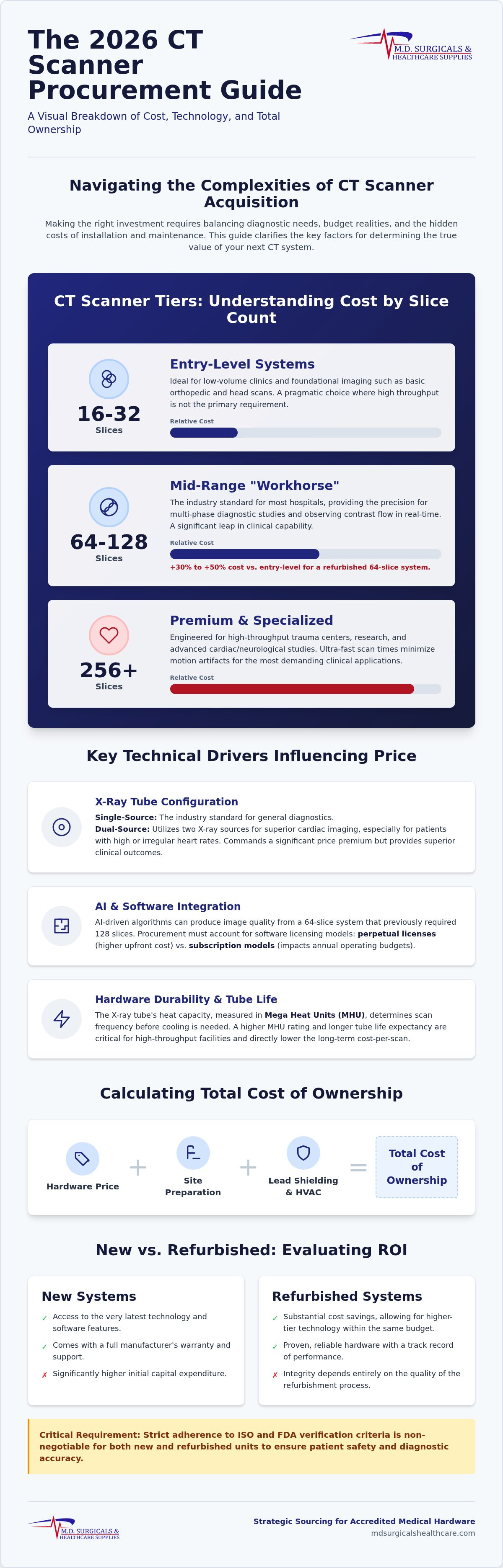
The fundamental driver of a ct scanner price is the system's slice count. This technical specification dictates the volume of anatomical data captured in a single 360-degree rotation of the X-ray tube. In 2026, the correlation between slice count and diagnostic speed remains the primary factor for procurement professionals evaluating institutional ROI. Higher slice counts allow for thinner anatomical sections, which results in superior image resolution and the ability to visualize smaller vascular structures with clinical precision.
Budgeting for Entry-Level and Mid-Range Units
Entry-level systems, typically featuring 16 to 32 slices, serve as the foundational hardware for routine diagnostic imaging. These units are well-suited for low-volume clinics or facilities focusing on basic orthopedic and head scans. While these systems offer a lower barrier to entry, their temporal resolution is often insufficient for advanced vascular or cardiac studies. They remain a pragmatic choice for facilities where high throughput isn't the primary operational requirement.
Mid-range systems, specifically 64-slice and 128-slice configurations, are the industry's primary "workhorse." A 64-slice system provides the necessary precision for multi-phase diagnostic studies. This allows clinicians to observe contrast flow through organs in real-time. For many medium hospitals, the transition from a 16-slice to a 64-slice unit represents a significant leap in clinical capability. Industry data suggests that moving to a 64-slice refurbished system can increase the ct scanner price by 30% to 50% compared to entry-level models. However, the increased throughput and diagnostic versatility often lead to a faster recovery of the initial capital expenditure.
Premium High-Slice Systems for Specialized Care
Premium systems featuring 256 slices or more are engineered for high-throughput environments like trauma centers and specialized research institutions. The technical complexity of these units allows for ultra-fast scan times. This is a critical advantage when imaging pediatric patients or individuals in emergency situations who can't remain still. By utilizing advanced CT scan technology, these systems capture entire organs in a fraction of a second.
In cardiology and neurology, high-slice counts are essential for minimizing motion artifacts. These artifacts occur when the heart's movement blurs the image, potentially leading to misdiagnosis. Dual-source systems, which utilize two X-ray tubes simultaneously, represent the upper end of this premium tier. While these units command a significant price premium, they provide the temporal resolution required for the most demanding clinical applications. Facilities prioritizing operational continuity and advanced patient care find these systems indispensable for maintaining a competitive edge in 2026.
The hardware architecture inside the gantry dictates the final ct scanner price just as much as the slice count. While slice count defines data volume, the X-ray tube configuration determines image clarity in motion. Single-source tubes are the industry standard for general diagnostics. Dual-source tubes utilize two independent X-ray sources and detectors. This configuration is essential for imaging patients with high or irregular heart rates without using beta-blockers. It's a significant technical driver that increases the initial capital outlay but provides superior clinical outcomes in cardiac care.The Role of AI and Software in 2026 Pricing
Artificial intelligence has fundamentally changed the procurement landscape. AI-driven image reconstruction algorithms now allow 64-slice systems to produce image quality that previously required 128 slices. This capability can offset the need for higher slice counts in certain clinical settings. However, these software features often come with recurring licensing fees. Procurement professionals must choose between perpetual licenses, which have a higher upfront cost, or subscription models that impact annual operating budgets. Integration with cloud-based Picture Archiving and Communication Systems (PACS) also requires specific DICOM compatibility, adding another layer of technical specification to the procurement process. If you're evaluating these complex technical trade-offs, sourcing verified diagnostic hardware through a strategic partner can clarify the total investment requirements.
Hardware Durability and Tube Life Expectancy
The longevity of the X-ray tube is a critical factor in calculating the cost-per-scan. Tube heat capacity, measured in Mega Heat Units (MHU), determines how many scans the machine can perform before requiring a cooling break. High-throughput facilities require tubes with heat capacities of 7.0 MHU or higher. Generator power also plays a role. A high-kilowatt (kW) generator provides the penetration needed for bariatric imaging, ensuring diagnostic clarity across diverse patient populations.
Cooling technology directly impacts both machine price and operational uptime. Air-cooled systems are less expensive to install. They're sensitive to ambient room temperature and may struggle during peak hours. Liquid cooling systems utilize dedicated chillers to maintain optimal tube temperatures. While these systems require a higher upfront investment and more complex site preparation, they offer the institutional reliability needed for 24/7 emergency departments. Wide-bore configurations, typically 78cm to 80cm, also command a premium. They improve patient comfort and accessibility for interventional procedures, though they require a larger gantry footprint.
New vs. Refurbished CT Scanners: Evaluating the ROI
Choosing between new and refurbished hardware is a strategic decision that impacts a facility's capital budget for a decade. A professionally refurbished 64-slice system often delivers over 90% of the clinical capability of a new unit at a fraction of the investment. Research indicates that the initial ct scanner price for pre-owned equipment typically ranges from 30% to 70% less than OEM list prices. However, a five-year ROI comparison must account for higher maintenance variables. For instance, replacing an X-ray tube on a refurbished system can cost between $50,000 and $120,000, while OEM service contracts for high-end new systems often range from $80,000 to over $200,000 annually. Institutional buyers must weigh these predictable service costs against the immediate capital savings of secondary market hardware.
Verification Standards for Refurbished Equipment
The secondary market requires a rigorous "Verification Standard" to ensure operational continuity. Sourcing from licensed distributors who provide accredited medical hardware verification is non-negotiable for institutional trust. You shouldn't just look at the price tag; you need to audit the system's provenance. This includes a thorough review of hardware revision history and software versioning to ensure the unit is compatible with 2026 cybersecurity protocols. Vetting service records reveals if the system was maintained under an OEM contract or by third-party specialists. This meticulousness prevents the acquisition of "end-of-life" hardware that may lack replacement part availability within the next three to five years.
When New Equipment is the Only Logical Investment
There are clinical and regulatory scenarios where only new equipment suffices. Advanced cardiac imaging requirements often mandate the latest photon-counting technology or ultra-premium 256-slice systems that haven't yet reached the refurbished market in significant volume. New systems also align with 2026 energy efficiency standards, which can reduce long-term operational costs in high-throughput trauma centers. These units come with the security of a full OEM warranty and comprehensive training packages that ensure staff proficiency from day one.
Technological obsolescence is another factor. If your facility requires a guaranteed ten-year service life with consistent software updates, the premium paid for a new ct scanner price is justified. New hardware often features the latest AI-integrated reconstruction tools as standard, whereas these may require expensive retrospective licensing on older models. For facilities focused on research or specialized neurology, the access to cutting-edge diagnostic tools and direct manufacturer support provides a level of institutional stability that refurbished units can't always match.
The invoice for the hardware is only the initial entry in a multi-layered procurement budget. To understand the true ct scanner price, institutional buyers must account for the total cost of ownership (TCO), which includes site preparation, logistical management, and long-term operational overhead. Neglecting these variables often leads to significant project delays and unbudgeted expenses that can impact a facility's financial stability.Global Logistics and Distribution Challenges
International procurement requires a sophisticated understanding of cross-border medical regulations. Moving a three-ton imaging gantry isn't a standard freight operation; it's a high-stakes logistical maneuver requiring "white-glove" delivery protocols to maintain hardware integrity and calibration. Institutional buyers should prioritize Delivered Duty Paid (DDP) terms. Under these terms, the distributor manages the complexities of customs, duties, and local accreditation compliance at the destination. This proactive approach prevents the risk of equipment being held at ports due to shifting 2026 shipping regulations for heavy diagnostic hardware. When you're ready to secure hardware that includes comprehensive logistical oversight, you can procure accredited medical imaging systems through our global distribution network.
Shielding and Facility Preparation Costs
Site preparation is a mandatory capital expense that varies based on the existing infrastructure. Industry data suggests that preparing a facility for a new installation can add between $50,000 and $200,000 to the total investment. This includes the installation of lead-lined walls and specialized control room glass to protect staff from ionizing radiation. Structural reinforcement is also a critical requirement. A high-weight imaging gantry requires specialized flooring to prevent structural shifting or vibrations that could compromise image quality. Additionally, medical-grade Uninterruptible Power Supply (UPS) systems are necessary to stabilize voltage and protect sensitive electronic components from power surges.
Ongoing operational expenses further influence the long-term ct scanner price. Service contracts for high-end systems typically range from $80,000 to over $200,000 annually, covering routine maintenance and software updates. Staff training is another essential budget item. As AI-driven image reconstruction becomes the standard in 2026, budgeting for technician certification on these new software platforms ensures your facility maximizes the diagnostic potential of the hardware. Finally, the high energy consumption of the gantry and the necessary HVAC systems to cool it must be integrated into the facility's monthly utility projections.
Procurement Strategy: Sourcing Through M.D. Surgical
Securing a competitive ct scanner price requires more than a simple comparison of OEM list prices. It demands a strategic partner capable of leveraging a global distribution network to identify high-value opportunities in the capital equipment market. M.D. Surgical & Healthcare Supplies operates as this logistical backbone, providing institutional buyers with a direct pipeline to verified, clinical-grade hardware. Our approach prioritizes operational continuity, ensuring that every piece of equipment undergoes a rigorous verification process before it reaches your facility. Institutional procurement is a high-stakes environment where supply chain reliability is just as critical as technical specifications. Our dedicated supply specialists manage the entire quote-to-delivery pipeline, providing transparency and meticulousness at every stage. We don't just deliver hardware; we deliver the institutional reliability required to maintain a consistent standard of care.
Institutional Support for Healthcare Facilities
We assist hospitals and clinics in navigating the complex regulatory landscape of medical procurement. By streamlining the Request for Quote (RFQ) process across multiple imaging modalities, including CT scanners, MRI scanners, and Ultrasound systems, we reduce the administrative burden on procurement departments. Our specialists develop customized shipping and verification protocols tailored to the specific requirements of international institutional buyers. This meticulous attention to detail ensures that the hardware meets all local accreditation standards upon arrival, preventing costly delays in clinical deployment. We understand that administrative clarity is essential for rapid decision-making, so our team provides highly organized, modular information that simplifies the approval process for hospital boards and directors.
The Logistical Backbone of Your Imaging Department
Maintaining a diagnostic department involves more than just the gantry itself. We anticipate supply chain gaps before they impact patient care by providing a reliable source for both capital hardware and high-volume consumables. Our distribution network allows facilities to combine equipment orders with essential supplies such as medical gloves, isolation gowns, and N95 respirators. This integrated sourcing model improves procurement efficiency and stabilizes the total ct scanner price by reducing fragmented shipping costs. We focus on the breadth of our global network to reinforce your facility's operational stability. By managing the end-to-end pipeline from sourcing to final delivery, we provide the administrative ease needed for long-term institutional planning. Request a professional quote for CT scanner procurement to begin the verification process for your facility's next diagnostic investment.
Optimizing Your Facility's Imaging Investment for 2026
Procuring high-value diagnostic hardware requires a strategic balance between clinical resolution and long-term financial sustainability. You've seen how technical drivers like slice count and AI-driven software influence the total ct scanner price, but hardware is only one component of the equation. Success depends on accounting for site preparation, shielding, and the logistical precision required for international delivery. Facilities that prioritize a comprehensive view of the total cost of ownership ensure operational continuity without unbudgeted capital strain.
M.D. Surgical & Healthcare Supplies serves as a licensed global distributor focused on the high-stakes needs of institutional buyers. We utilize a rigorous hardware verification process to ensure every gantry meets clinical standards before shipment. Our global network allows us to provide competitive wholesale pricing while managing complex cross-border logistics. Contact our supply specialists for a customized capital equipment quote to secure the reliable diagnostic backbone your imaging department requires. We look forward to supporting your facility's long-term operational success.
Frequently Asked Questions
What is the average price of a 64-slice CT scanner in 2026?
Market data for 2026 indicates that a 64-slice ct scanner price varies significantly between new and professionally refurbished configurations. A new mid-range system typically requires a capital investment between $400,000 and $750,000. Conversely, facilities often acquire refurbished 64-slice units for $175,000 to $350,000 all-in. These figures represent industry averages for the hardware alone and don't include the specific logistical or installation fees associated with your facility's unique site requirements.
How much does it cost to install a CT scanner in a new clinic?
Installation expenses typically add between $50,000 and $200,000 to your total project budget. This range covers essential site preparation such as lead-lined walls, specialized control room glass, and structural floor reinforcement for the imaging gantry. You must also account for medical-grade electrical stabilization and high-capacity HVAC systems. These environmental controls are necessary to maintain the precise operating temperatures required for the X-ray tube, ensuring long-term hardware reliability and diagnostic accuracy.
Is it better to buy a refurbished CT scanner or a new entry-level unit?
A professionally refurbished 64-slice system often provides superior clinical value compared to a new entry-level 16-slice unit. While a new unit offers a full manufacturer warranty, its limited slice count may restrict your ability to perform advanced cardiac or neurological studies. Refurbished 64-slice systems deliver approximately 90% of the capability of current premium models at a lower ct scanner price. This allows clinics to increase patient throughput and diagnostic versatility without the premium cost of new hardware.
What are the hidden costs associated with CT scanner maintenance?
The most significant hidden cost is the eventual replacement of the X-ray tube, which typically ranges from $50,000 to $120,000 depending on the heat capacity. Annual service contracts also represent a substantial ongoing expense, often costing between $80,000 and $200,000 for high-end systems. Other operational costs include specialized software licensing fees, high electricity consumption for the gantry and cooling systems, and regular technician training to ensure staff proficiency with updated AI-driven reconstruction platforms.
Does M.D. Surgical provide international shipping for CT scanners?
M.D. Surgical & Healthcare Supplies operates as a licensed global distributor providing comprehensive international shipping for all diagnostic imaging systems. We manage the entire logistical pipeline, including accredited hardware verification and customs clearance. Our team utilizes "white-glove" delivery protocols to ensure the integrity of heavy capital equipment during transit. We prioritize operational continuity for institutional buyers by navigating local regulatory requirements and ensuring that all hardware arrives ready for immediate clinical installation.
How do AI software features impact the overall machine price?
AI-driven image reconstruction features impact the machine price by either increasing the upfront capital cost or introducing recurring software licensing fees. These advanced algorithms can enhance the image resolution of a lower-slice system, potentially allowing a 64-slice unit to perform like a 128-slice model. While this can reduce hardware costs, the subscription models for AI software add to the long-term operational budget. Procurement professionals must decide between perpetual licenses and annual subscription-based access.
What electrical and shielding requirements are necessary for a CT scan room?
A standard CT scan room requires lead shielding in the walls and doors to protect staff and patients from ionizing radiation. Specialized lead glass is also necessary for the operator's control booth. Electrically, the room must have a dedicated high-voltage power supply and a medical-grade Uninterruptible Power Supply (UPS) to prevent data loss during surges. High-capacity HVAC systems are mandatory to dissipate the significant heat generated by the X-ray tube during continuous high-throughput operations.
How long does the procurement and delivery process take for imaging equipment?
The procurement timeline for high-value imaging hardware involves several critical stages, including sourcing, rigorous hardware verification, and international transit. While specific durations vary based on the destination and regulatory requirements, the process is designed to be methodical and efficient. Our supply specialists coordinate the entire pipeline to anticipate potential supply chain gaps before they impact your facility's operations. This structured approach ensures that all accreditation standards are met and that the hardware arrives within a predictable window.

