

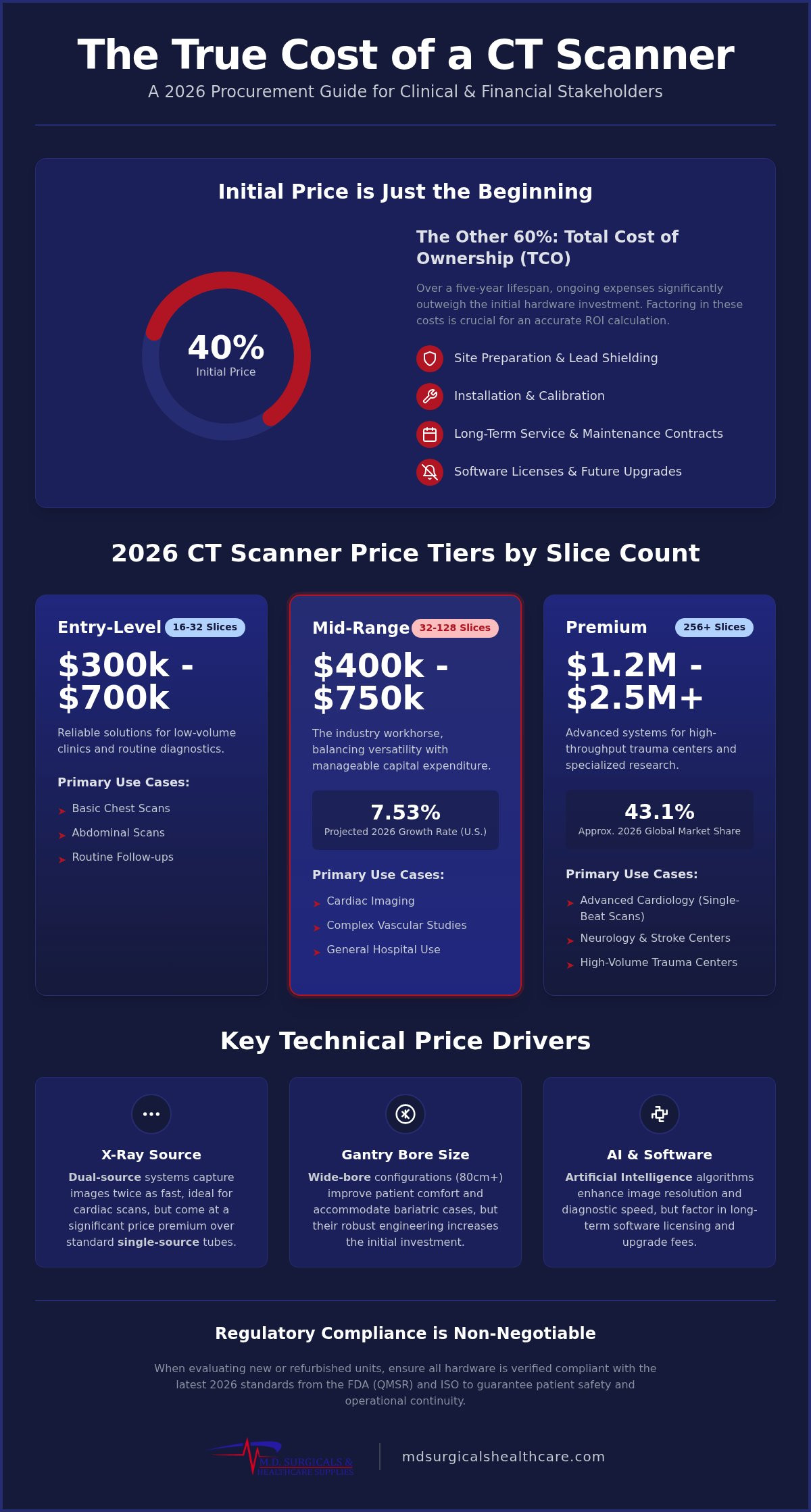
Did you know that the initial ct scanner price typically represents only 40% of the total cost of ownership over five years? For procurement managers and clinical directors in September 2026, the sticker price is just the beginning of a complex financial equation. You likely feel the pressure to balance innovation with tightening institutional budgets. It's a high-stakes decision where hidden fees for shielding, installation, and long-term service contracts can quickly erode your projected return on investment.
M.D. Surgical & Healthcare Supplies prioritizes operational continuity through transparent data and rigorous hardware verification. This guide provides a comprehensive breakdown of the 2026 market, ranging from entry-level 16-slice units to advanced photon-counting technology. We'll examine the technical drivers behind current pricing tiers and establish a framework for calculating Total Cost of Ownership (TCO). You'll also learn how to evaluate refurbished units and manage the logistical hurdles of international shipping for heavy medical hardware.
Key Takeaways
- Understand how slice counts from 16 to 256+ dictate the base ct scanner price and clinical utility for your specific facility.
- Identify how technical specifications like dual-source X-ray tubes and Artificial Intelligence (AI) software impact both image resolution and long-term software licensing fees.
- Evaluate the five-year Return on Investment (ROI) of refurbished hardware by verifying compliance with 2026 Food and Drug Administration (FDA) and International Organization for Standardization (ISO) standards.
- Calculate the Total Cost of Ownership (TCO) by accounting for essential site preparation, including lead shielding and specialized HVAC requirements.
- Discover how to leverage a global distribution network to maintain operational continuity while navigating the complexities of international medical equipment logistics.
CT Scanner Price Tiers: Understanding Cost by Slice Count
In September 2026, the primary factor influencing a ct scanner price remains the slice count. This metric refers to the number of cross-sectional images a system acquires in a single rotation of the X-ray tube. Higher slice counts translate directly to faster diagnostic speed and enhanced image resolution, which are critical for patient safety and throughput. Computed tomography (CT) has evolved significantly, moving from routine anatomical imaging to complex physiological assessments. It's a strategic decision for institutions to weigh these technical capabilities against their specific clinical volume to ensure operational continuity.
To better understand how these technical tiers impact your budget, watch this helpful video:
Budgeting for Entry-Level and Mid-Range Units
Entry-level systems, typically featuring 16 to 32 slices, are priced between $300,000-$700,000 for new units as of late 2026. These models serve as reliable solutions for low-volume clinics or routine diagnostics like basic chest and abdominal scans. However, the 64-slice configuration has become the industry's cost-effective workhorse. Mid-range systems (32 to 128 slices) generally range from $400,000-$750,000. These units provide the multi-phase diagnostic capabilities necessary for cardiac imaging and more complex vascular studies. Hospitals often select these for their balance of clinical versatility and manageable capital expenditure. Procurement managers should recognize that these mid-tier scanners are the fastest-expanding segment in the United States, with a projected 7.53% growth rate in 2026.
Premium High-Slice Systems for Specialized Care
Facilities requiring high-throughput for trauma centers or advanced research environments should focus on premium systems with 256 slices or more. These advanced units carry a significant price premium, often starting at $1,200,000 and exceeding $2,500,000. The investment is justified in cardiology and neurology, where ultra-fast scan times are essential to reduce motion artifacts. For instance, a 256-slice scanner can capture a complete image of the heart in a single beat. This capability improves the patient experience by reducing the need for breath-holding and sedatives in emergency settings.
The global market for these high-slice systems is expanding. According to 2026 market data, they represent approximately 43.1% of the global market share. While the upfront ct scanner price is higher, the increased diagnostic accuracy often leads to a more favorable long-term ROI for major medical institutions. You can explore a variety of these systems through our curated selection of CT Scanners. All procurement through M.D. Surgical & Healthcare Supplies adheres to the latest February 2026 FDA Quality Management System Regulation (QMSR) standards.
Technical Drivers: What Determines Diagnostic Equipment Cost?
Beyond the basic slice count, several internal hardware and software components determine the final ct scanner price. The choice between single-source and dual-source X-ray tubes is a primary consideration for specialized departments. While single-source systems handle most routine diagnostics, dual-source systems utilize two tubes and two detectors to capture images at twice the speed. This technology is indispensable for cardiac imaging in patients with high heart rates, though it carries a significant price premium. Additionally, the physical architecture of the gantry, specifically the bore size, impacts the budget. Wide-bore configurations, often 80 centimeters or larger, improve patient comfort and accommodate bariatric cases; however, they require more robust engineering that increases the initial investment.
Understanding these technical nuances is vital for accurate budgeting and clinical efficacy. For a deeper look at the historical economic factors, the report on Policy Implications of the CT Scanner by Princeton University provides a foundational perspective on operational fees. If you're evaluating specific configurations for your facility, you can contact our procurement specialists for a detailed technical consultation.
The Role of AI and Software in 2026 Pricing
In 2026, the integration of Artificial Intelligence (AI) has shifted how institutions value hardware. AI-driven image reconstruction allows a 64-slice scanner to achieve the diagnostic clarity previously reserved for higher-tier machines. This reduces the radiation dose for patients, aligning with the latest safety initiatives. However, these capabilities often come with ongoing costs:
- Software licensing fees, which range from $15,000 to $60,000 annually.
- Subscription models that replace one-time perpetual licenses.
- Integration requirements for Digital Imaging and Communications in Medicine (DICOM) to ensure seamless data transfer.
Hardware Durability and Tube Life Expectancy
The X-ray tube is the most critical consumable in the system, with replacement costs ranging from $35,000 to $130,000 per unit. Procurement managers must evaluate the tube's heat capacity and cooling mechanism to predict long-term expenses. Liquid cooling systems are more expensive upfront but are necessary for high-volume trauma centers to prevent machine downtime. Generator power, measured in kilowatts (kW), also affects the ct scanner price; higher power allows for better imaging depth in larger patients without sacrificing speed. Choosing the right cooling and power configuration ensures your facility avoids the supply chain gaps that can impact daily operations.
New vs. Refurbished CT Scanners: Evaluating the ROI
Deciding between a new or refurbished unit is a pivotal step in managing your facility's capital budget. A professionally refurbished 64-slice scanner often provides over 90% of the clinical utility of a new machine while reducing the upfront ct scanner price by 30% to 70%. In September 2026, a refurbished 64-slice configuration typically costs $150,000-$190,000. This is a substantial saving compared to the $700,000-$1,200,000 required for a new advanced 64-slice model.
You've got to remember that the purchase price is only 40% of the five-year total cost. Institutional buyers must weigh these initial savings against long-term maintenance and parts availability. Refurbished units sourced through a dedicated supply specialist often include verified service records and updated software. This ensures the system remains viable for a seven to 10-year service life.
Our team at M.D. Surgical & Healthcare Supplies acts as a strategic partner to help you navigate these financial trade-offs. We focus on providing hardware that maintains operational continuity without compromising diagnostic precision. You can view our current inventory of verified CT Scanners to compare specific models and their impact on the overall ct scanner price for your facility.
Verification Standards for Refurbished Equipment
Sourcing pre-owned hardware requires a rigorous verification framework to ensure institutional safety. As of February 2, 2026, the Food and Drug Administration (FDA) implemented the Quality Management System Regulation (QMSR). This regulation aligns U.S. requirements with the International Organization for Standardization (ISO) 13485:2016 standard. You shouldn't purchase any unit without a documented hardware revision history and software versioning report.
When New Equipment is the Only Logical Investment
There are scenarios where new equipment is the only logical choice for specialized care. Advanced cardiac imaging and photon-counting diagnostics often require the latest hardware that isn't yet available on the secondary market. New systems also meet 2026 energy efficiency standards, which can lower your monthly utility expenses. These units come with comprehensive Original Equipment Manufacturer (OEM) training and installation packages to ensure your clinical staff is proficient with the latest usability features.
Beyond Hardware: Total Cost of Ownership and Logistics
Procurement professionals often find that the ct scanner price is just the entry point for a much larger financial commitment. According to September 2026 market data, the initial purchase price accounts for only about 40% of the true five-year cost. The remaining 60% is comprised of service contracts, site modifications, and consumable components. M.D. Surgical & Healthcare Supplies operates as a strategic partner to help you forecast these expenses and maintain operational continuity.
Global Logistics and Distribution Challenges
Moving heavy diagnostic equipment across international borders requires meticulous planning. You've got to account for customs duties and rigorous accreditation compliance at the destination. We recommend utilizing Delivered Duty Paid (DDP) terms to simplify the process for institutional buyers. This ensures the distributor handles all import formalities and costs, reducing the risk of unexpected delays in the supply chain.
White-glove medical delivery is also essential to ensure the hardware is handled by specialists trained in moving sensitive diagnostic machinery. In 2026, shipping regulations for heavy diagnostic equipment have become more stringent. Global distributors must verify that each unit meets the destination country's specific regulatory standards before it leaves the warehouse. This verification process prevents the equipment from being impounded at customs, which can lead to catastrophic operational gaps.
Shielding and Facility Preparation Costs
Site preparation and installation typically cost between $30,000-$80,000. This includes lead-lined walls, specialized control room glass, and structural floor reinforcement to support the imaging gantry's weight. Specialized medical-grade UPS systems are also necessary to stabilize the power supply and protect sensitive electronics from fluctuations. HVAC systems must be upgraded to manage the significant heat output of the X-ray tube.
A complete room build-out can cost $80,000-$250,000 depending on the existing infrastructure. Ongoing operational expenses are a significant part of the budget. Annual service contracts generally cost 8% to 12% of the initial ct scanner price. You must also budget for X-ray tube replacements and electricity costs that vary based on scan volume.
Staff training is another critical factor; technicians must be certified on new software platforms to ensure patient safety and diagnostic accuracy. These certification programs often require a separate budget for travel or third-party proctoring. To streamline your equipment acquisition and manage these logistical complexities, you can review our international shipping policy for detailed information on global delivery standards.
Strategic Procurement: Sourcing Through M.D. Surgical
M.D. Surgicals & Healthcare Supplies operates as a specialized distributor to ensure your facility maintains operational continuity. We leverage a global network to provide competitive wholesale pricing on capital equipment. This approach allows us to secure hardware that meets your technical requirements without the typical markups of smaller retail entities. Our team manages the entire quote-to-delivery pipeline, ensuring that the final ct scanner price you pay reflects a transparent, verified transaction. We act as a strategic partner, focusing on the long-term reliability of your imaging department.
Institutional Support for Healthcare Facilities
We assist hospitals and clinics in meeting the stringent 2026 regulatory procurement standards. Our specialists streamline the Request for Quote (RFQ) process, allowing you to manage multiple imaging modalities through a single point of contact. This is particularly beneficial for international institutional buyers who require customized shipping and verification protocols. We ensure every unit is accredited and compliant with the February 2026 FDA Quality Management System Regulation (QMSR) before it reaches your site. This meticulousness reduces the administrative burden on your procurement office and ensures clinical safety.
Managing the complexities of global distribution requires a partner with unwavering stability. We provide the technical documentation and accreditation proof necessary for institutional audits. Our goal is to make the transition from identifying a need to offering a solution as direct as possible. You'll receive clear communication throughout the shipping process, from warehouse verification to white-glove installation.
The Logistical Backbone of Your Imaging Department
Our role goes beyond a single hardware transaction. We anticipate supply chain gaps before they impact your patient care. You can combine your capital equipment orders with wholesale medical consumables to improve administrative efficiency. This integrated approach ensures that your imaging department has a steady supply of contrast media and N95 respirators (NIOSH-approved) to maintain safety protocols. Maintaining this continuity is essential for high-volume centers that cannot afford downtime due to missing consumables.
By consolidating your procurement, you reduce the logistical friction of managing separate vendors for hardware and daily supplies. We provide the stability your administration needs to focus on clinical outcomes rather than shipping delays. Our dedicated supply specialists remain vigilant, positioning us as a dependable logistical backbone for your institution. When evaluating the total ct scanner price, factor in the value of a partner that ensures operational continuity. You'll find that our global reach and technical precision create a sense of professional ease for your entire team.
Request a professional quote for CT scanner procurement to begin your technical consultation today.
Optimizing Your Diagnostic Infrastructure for 2026
Selecting a CT scanner in late 2026 requires a comprehensive understanding of how technical specifications and logistical variables influence the final ct scanner price. You've seen that the initial purchase represents just a fraction of the total cost of ownership. Accurate budgeting must account for site preparation, software licensing, and specialized maintenance to ensure your facility avoids operational gaps. Balancing these expenses with clinical throughput demands is essential for maintaining a positive five-year return on investment.
M.D. Surgicals & Healthcare Supplies acts as a dependable logistical backbone for institutions worldwide. As a licensed global distributor of diagnostic imaging, we provide a rigorous hardware verification process and competitive wholesale pricing for institutional buyers. We understand the high-stakes nature of healthcare procurement and prioritize your facility's stability. Our specialists are ready to assist you in navigating the complexities of international shipping and regulatory compliance.
Contact our supply specialists for a customized capital equipment quote to begin your procurement journey. We're committed to helping you build a resilient imaging department that delivers exceptional patient care with administrative clarity.
Frequently Asked Questions
What is the average price of a 64-slice CT scanner in September 2026?
In September 2026, the average ct scanner price for a new 64-slice system ranges from $700,000 to $1,200,000. If you opt for a professionally refurbished intermediate model, the cost typically falls between $150,000 and $190,000. These mid-range systems are currently the fastest-expanding segment in the U.S. market. They offer a balance of cardiac imaging capability and manageable capital expenditure for medium-sized hospitals and outpatient centers.
How much does it cost to install a CT scanner in a new clinic?
Installation costs for a new clinic generally range from $80,000 to $250,000 for a complete room build-out. This includes specialized site preparation such as lead shielding and structural floor reinforcement. Basic delivery and technical installation typically add another $10,000 to $30,000 to your budget. You should also account for approximately $30,000 to $80,000 specifically for radiation shielding and HVAC upgrades to manage the machine's heat output during operation.
Is it better to buy a refurbished CT scanner or a new entry-level unit?
Choosing a refurbished 64-slice scanner often provides better clinical utility than a new 16-slice entry-level unit. A refurbished model can deliver 90% of the diagnostic capability of new hardware at 30% to 70% lower cost. This allows smaller clinics to access advanced features like cardiac imaging without exceeding their budget. However, new units may be preferable if your facility requires the latest 2026 energy efficiency standards or specific manufacturer training packages.
What are the hidden costs associated with CT scanner maintenance?
Maintenance costs include annual service contracts that range from 8% to 12% of the initial purchase price. For high-end systems, these contracts can exceed $200,000 annually. You must also budget for X-ray tube replacements, which cost between $35,000 and $130,000 depending on the model. Software licenses and periodic feature upgrades add another $15,000 to $60,000 in yearly operational expenses that aren't always covered by basic service agreements or original warranties.
Does M.D. Surgical provide international shipping for CT scanners?
Yes, M.D. Surgical & Healthcare Supplies provides comprehensive international shipping and logistical support for all diagnostic imaging equipment. We manage the entire distribution process, including rigorous hardware verification and customs compliance for institutional buyers. Our global network ensures that heavy medical hardware reaches its destination securely through white-glove delivery services. We specialize in navigating complex 2026 shipping regulations to maintain your facility's operational continuity across international borders regardless of your location.
How do AI software features impact the overall machine price?
AI integration significantly increases the total ct scanner price through ongoing software licensing fees rather than just the upfront hardware cost. These features enhance image reconstruction and reduce radiation doses, which adds significant clinical value. Annual licenses for advanced AI features typically range from $15,000 to $60,000. While AI can allow a mid-tier scanner to perform like a premium unit, you should factor these recurring subscription costs into your five-year financial projections.
What electrical and shielding requirements are necessary for a CT scan room?
A standard scan room requires lead-lined walls and specialized control room glass to meet radiation safety standards. You'll need medical-grade uninterruptible power supply (UPS) systems to stabilize the electrical current and protect sensitive detectors. Structural floor reinforcement is often necessary to support the high weight of the imaging gantry. Additionally, upgraded HVAC systems are mandatory to dissipate the heat generated by the X-ray tube during high-volume diagnostic sessions to prevent equipment failure.
How long does the procurement and delivery process take for imaging equipment?
The timeline for procurement and delivery typically varies based on the unit's configuration and the destination's regulatory requirements. Global shipping for heavy diagnostic equipment involves meticulous verification and customs clearance, which can extend lead times. Our dedicated supply specialists work to streamline the quote-to-delivery pipeline to minimize delays. We focus on anticipating supply chain gaps to ensure your facility receives its accredited hardware as efficiently as possible while maintaining all international safety standards.


