

Healthcare facilities must meet updated Americans with Disabilities Act (ADA) standards for medical diagnostic equipment by the August 2026 compliance deadline, impacting how imaging suites are designed and operated. You're likely managing the complex task of sourcing a high-performance ct scan machine while navigating supply chain instability and the rigorous requirements of international accreditation. It's a difficult balance to maintain clinical excellence alongside a sustainable return on investment in a volatile market. Stability is paramount.
Securing this equipment requires more than just reviewing a spec sheet; it demands a deep understanding of logistical verification and regulatory compliance. This guide provides a comprehensive technical and procurement overview of current imaging technology to help you make informed institutional decisions. You'll understand the specific clinical benefits of modern systems and evaluate the technical specifications required for 2026 standards. We'll also outline how to identify reliable global distribution partners to ensure your operational continuity remains uninterrupted despite global logistical challenges.
Key Takeaways
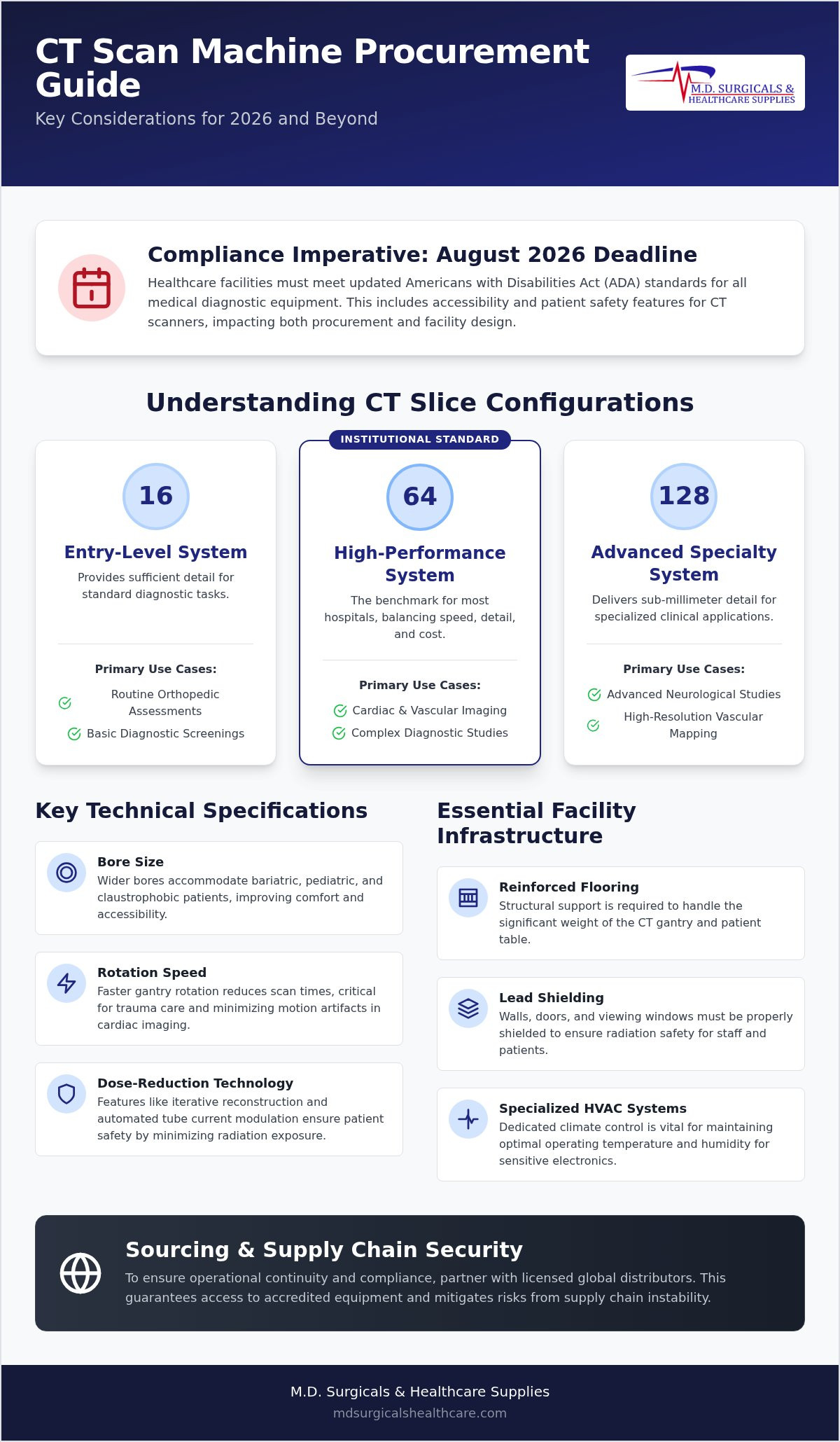
- Understand how slice configurations, ranging from entry-level 16-slice to advanced 128-slice systems, impact image resolution and diagnostic speed.
- Identify the essential facility infrastructure required for successful installation, including reinforced flooring, lead shielding, and specialized HVAC systems.
- Evaluate technical specifications like bore size and rotation speed to optimize workflows for pediatric, cardiac, and bariatric patient populations.
- Learn the critical steps for sourcing an accredited ct scan machine through a licensed distributor to ensure global compliance and supply chain security.
- Ensure your imaging department remains compliant with the August 2026 ADA standards for medical diagnostic equipment accessibility and patient safety.
Understanding CT Scan Machine Technology and Clinical Utility
A ct scan machine is a sophisticated diagnostic imaging instrument designed to provide detailed anatomical visualization. It operates by utilizing rotating X-ray techniques that capture multiple images from various angles around the patient's body as the X-ray tube moves within the gantry. These raw data points are processed to create cross-sectional images, or slices, which offer a much higher level of detail than standard radiography. This clarity is essential for modern diagnostic workflows where precision is non-negotiable.
The internal computer system plays a critical role in data reconstruction. It interprets the absorption rates of the X-ray beams to distinguish between soft tissue, bone, and blood vessel structures. This precision allows clinicians to accurately diagnose bone tumors, complex spiral fractures, and critical internal bleeding in organs like the liver or spleen. Modern CT scan technology has become indispensable for identifying pathologies that remain obscured in traditional two-dimensional imaging, providing a three-dimensional perspective that informs surgical planning.
The Evolution of the CAT Scan Machine
The technology has advanced significantly from early axial tomography to the high-speed multi-slice scanners used today. While older systems were limited in their capture speed and resolution, September 2026 imaging software now leverages 128-bit digital processing to enhance image clarity and reduce reconstruction times. Clinical staff often use the terms interchangeably; however, it's helpful to recognize that the cat scan machine (computed axial tomography) represents the foundational nomenclature for what we now more broadly categorize as CT. This shift reflects the move from simple axial slices to complex, multi-planar reconstructions that allow for better diagnostic accuracy in neurological and vascular assessments.
Clinical Benefits in Emergency and Surgical Care
Speed is the defining factor in trauma settings. High-resolution imaging allows surgical teams to identify life-threatening internal injuries within seconds, which is vital for the "golden hour" of trauma care. These scans also provide essential guidance for needle biopsies and the precise mapping of radiation therapy targets for oncology patients. To maintain patient safety during these high-stakes procedures, these systems often integrate with Patient Monitors to track real-time vitals such as heart rate and oxygen saturation. This synergy ensures that clinicians can react immediately to physiological changes while the ct scan machine completes its diagnostic sequence. This level of integration is a cornerstone of modern emergency medicine and institutional reliability.
Technical Specifications and Imaging Modalities
The slice count of a ct scan machine serves as the primary benchmark for institutional performance and diagnostic precision. This specification dictates the volume of anatomical data captured during a single 360-degree rotation of the X-ray tube. Higher slice counts directly correlate with improved spatial resolution and significantly faster acquisition speeds. These factors are critical when imaging dynamic structures or managing uncooperative patients who cannot remain still for extended periods.
Entry-level 16-slice systems are typically sufficient for routine orthopedic assessments and basic diagnostic screenings. In contrast, advanced 64-slice and 128-slice configurations provide the sub-millimeter detail required for complex vascular and neurological studies. To achieve maximum visibility of blood vessels and hypervascular tumors, clinicians often utilize contrast material. This agent increases the attenuation of X-ray beams, allowing software to render clear distinctions between pathological lesions and healthy parenchyma.
Managing patient safety is a core requirement for any modern imaging department. Current systems integrate advanced dose-reduction technologies, such as iterative reconstruction and automated tube current modulation, to maintain image quality at the lowest possible exposure levels. For a deeper understanding of these protective standards, clinicians should consult official guidelines on CT scan radiation safety to ensure their protocols align with international benchmarks.
Multi-Slice CT Capabilities
In the current clinical landscape, 64-slice machines represent the institutional standard for cardiac imaging. Their ability to capture the entire heart in just a few heartbeats minimizes motion artifacts. Hospitals with high patient volumes often prioritize 128-slice systems to maximize daily throughput and reduce wait times. If your facility requires metabolic characterization, such as identifying gout crystals or kidney stone composition, dual-energy CT imaging is necessary. This modality uses two different X-ray spectra to differentiate materials based on their unique attenuation profiles.
Software Integration and Data Management
Operational efficiency depends on seamless connectivity across the healthcare enterprise. Every ct scan machine must maintain full DICOM (Digital Imaging and Communications in Medicine) compliance to ensure interoperability with existing Hospital Information Systems (HIS) and PACS. As of September 2026, AI-driven software has become a standard feature for automated lesion detection and real-time image sharpening. These tools help radiologists prioritize critical cases and reduce diagnostic errors. Because these datasets are massive, your facility must have high-speed fiber-optic infrastructure to support rapid data transmission and remote viewing.
Selecting the correct modality requires a careful analysis of your specific clinical goals and patient demographics. If you're currently evaluating system configurations for an upcoming installation, contact our technical team for a detailed procurement consultation.
Evaluating Machine Performance: Slices, Speed, and Software
Performance evaluation of a ct scan machine requires looking beyond slice count to gantry rotation speed. High-speed gantries, often rotating in less than 0.35 seconds, are vital for cardiac and pediatric imaging. These speeds minimize motion artifacts, ensuring diagnostic clarity without requiring patients to hold their breath for extended periods. For more information on the clinical process, refer to the Computed Tomography (CT) Scan overview provided by Stanford Health Care.
Bore size is another critical performance metric for institutional buyers. A wider gantry aperture, typically 80 centimeters or larger, improves bariatric accessibility and enhances patient comfort. This design choice reduces the rejection rate for claustrophobic patients, directly impacting the facility's operational efficiency. Advanced reconstruction algorithms further define image quality by processing raw data through specific mathematical filters. These kernels sharpen bone edges for orthopedic work while smoothing soft tissue for oncology screenings.
Optimizing Patient Throughput
Workflow efficiency is a primary driver of institutional return on investment. Automated table positioning and zero-click protocols reduce the time required for patient setup. User-friendly interfaces allow clinical staff to focus on patient care rather than navigating complex software menus. Faster scan times don't just improve the patient experience; they allow diagnostic centers to increase daily scan volumes. This efficiency ensures the ct scan machine remains a productive asset in high-traffic environments.
Maintenance and Long-Term Reliability
High-performance X-ray tubes are the most critical components in a heavy-use environment. These tubes require a strict preventative maintenance schedule, often performed quarterly, to prevent unexpected downtime. Sourcing verified replacement parts through a licensed distributor ensures that the equipment maintains its original performance specifications. Additionally, software updates in September 2026 are mandatory for maintaining regulatory compliance and ensuring that the latest dose-reduction features are active. Meticulous record-keeping and scheduled service intervals are the backbone of clinical stability and equipment longevity.
Procurement Logistics and Facility Requirements
Installing a ct scan machine is a significant capital project that demands precise architectural and engineering coordination. Success depends on more than just the hardware; it requires a facility capable of supporting high-voltage operations and radiation safety protocols. Lead shielding must be integrated into the walls, floors, and ceilings of the scan room to meet international safety standards. Additionally, reinforced flooring is essential to support the weight of the gantry, which can exceed several thousand pounds.
Continuous operation also relies on a robust power supply and cooling infrastructure. These systems typically require a dedicated 480V, three-phase power connection to ensure voltage stability during high-load scans. Specialized HVAC (Heating, Ventilation, and Air Conditioning) systems must maintain a consistent temperature and humidity level to protect the sensitive detector arrays from thermal drift. High-end imaging equipment in this category generally falls within pricing ranges of $50,000–$500,000+, depending on slice count and software packages.
Facility Preparation and Shielding Standards
Room dimensions must provide adequate clearance for full gantry rotation and unimpeded patient access, typically requiring a minimum of 250 to 400 square feet. This space must also accommodate the operator console and power distribution units. Environmental controls are critical; even minor fluctuations in ambient temperature can degrade image quality or trigger system shutdowns. Specialized technicians are responsible for the physical installation, ensuring the gantry is perfectly leveled and the laser alignment systems are calibrated to sub-millimeter accuracy.
Procurement Framework for Hospital Managers
In the fiscal landscape of September 2026, a standard 64-slice scanner typically achieves a full return on investment within three to five years depending on scan volume and reimbursement rates. Institutional buyers often find significant advantages in wholesale medical supply sourcing, which offers better pricing structures for bulk equipment orders. When evaluating options, it's vital to contrast the acquisition of brand-new units with accredited and verified equipment. Choosing verified systems ensures that every ct scan machine meets original manufacturer specifications and global compliance standards before it enters your clinical workflow.
Logistical coordination moves from order placement through a rigorous verification process before international delivery. We manage this through our global network of four regional hubs to ensure supply chain stability and timely arrival at your facility. This methodical approach ensures that your equipment is secure, compliant, and ready for immediate clinical use.
Sourcing Accredited Imaging Equipment Globally
Sourcing a ct scan machine requires a strategic partnership with a licensed distributor capable of managing the complexities of international trade and medical regulations. High-value diagnostic equipment demands a rigorous chain of custody to prevent delays and ensure patient safety. Our verification process is comprehensive; all products are accredited and verified before sale to guarantee they meet strict clinical standards. This meticulous approach eliminates the risks associated with unverified secondary markets and ensures your facility receives hardware that is ready for immediate integration into the clinical environment.
Security remains a cornerstone of our procurement process. We utilize a PCI DSS compliant checkout and 128-bit SSL encryption to protect every transaction. These protocols provide institutional buyers with the confidence that their financial data and procurement details are handled with the highest level of administrative clarity. By maintaining a global network across four regional hubs, including NORAM, LATAM, EMEA, and APAC, we provide the logistical backbone necessary for supply continuity in an unpredictable market.
Global Supply Chain and Regional Support
As of September 2026, our regional hubs are strategically positioned to provide localized expertise and rapid response times. For procurement teams in North America, Mr. Lucas A. Everhart leads our NORAM operations, while Mr. Alfred Pelland oversees the EMEA region. These hubs ensure that a critical ct scan machine or monitoring system is stocked and shipped before your ward runs short, minimizing the impact of global supply chain gaps. We also provide multi-language support for our APAC and LATAM procurement partners to ensure that technical specifications and regulatory requirements are communicated with absolute precision.
The M.D. Surgical & Healthcare Supplies Customer Promise
Our commitment to excellence is reflected in our core promise: Low Prices · Large Selection · Satisfaction Guaranteed · Secure Shopping. M.D. Surgical & Healthcare Supplies has built a legacy over many years as a dependable logistical backbone for healthcare providers worldwide, specializing in the distribution of advanced diagnostic and monitoring systems. This experience allows us to offer a level of professional authority that traditional retail entities cannot match. If your facility is planning an imaging upgrade or a new installation, we invite you to Contact a specialist for a custom quote tailored to your specific clinical and budgetary requirements.
Advancing Institutional Imaging Capabilities for 2026
Modernizing your facility's diagnostic floor requires a synergy between technical specification and logistical excellence. You've evaluated how slice counts and rotation speeds influence patient outcomes and how specialized facility infrastructure supports high-load operations. These decisions are the foundation of clinical precision. Stability in your supply chain remains the final piece of the operational puzzle.
M.D. Surgical & Healthcare Supplies serves as your strategic partner in this complex landscape. We offer a legacy built over many years as a licensed distributor focused on institutional reliability. Every ct scan machine in our inventory is accredited and verified before sale to ensure it meets rigorous safety standards. Your procurement process is further protected by secure shopping protocols, including 128-bit SSL encryption and PCI DSS compliance.
We're ready to support your facility's goals through our global network of regional hubs. Our teams anticipate supply chain gaps before they impact your ward's efficiency. We look forward to ensuring your imaging department remains at the forefront of patient safety throughout September 2026 and beyond.
Frequently Asked Questions
What is the exact price range for a professional CT scan machine in 2026?
In the current fiscal landscape, high-end imaging hardware typically falls within the price range of $50,000–$500,000+. This range accounts for the technical complexity of the ct scan machine, including slice count and integrated AI software. As a licensed distributor, we provide transparent wholesale pricing to help procurement managers balance their ROI with clinical efficacy. These figures reflect the total cost of sourcing accredited and verified equipment for institutional use.
How does a CT scan machine differ from an MRI scanner in clinical use?
The primary difference lies in the imaging technology and clinical application. A ct scan machine utilizes rotating X-rays to capture detailed images of bone and dense tissues, making it the preferred choice for trauma and acute fractures. MRI scanners use magnetic fields to visualize soft tissues like ligaments or the brain. While CT scans are significantly faster, MRI provides higher contrast for neurological studies without the use of ionizing radiation.
Are all imaging machines accredited and verified before being shipped?
Yes, our strict quality control protocols dictate that all products are accredited and verified before sale. This process ensures that every diagnostic instrument meets international safety and performance standards before it enters your clinical workflow. We maintain a legacy built over many years as a strategic partner for healthcare providers, ensuring that institutional reliability is never compromised. This verification is essential for maintaining supply chain stability and patient safety.
What are the facility requirements for installing a high-end CT scanner?
Successful installation requires a room with integrated lead shielding and reinforced flooring to support the gantry's weight. You must also ensure a dedicated 480V, three-phase power supply and a specialized HVAC system to protect sensitive detector arrays from temperature fluctuations. These environmental controls are vital for maintaining image clarity and preventing equipment downtime. Planning these infrastructure needs well in advance helps avoid costly logistical delays during the final installation phase.
Can I purchase a CT scan machine for international delivery?
We facilitate global procurement through our global network across four regional hubs, including NORAM, LATAM, EMEA, and APAC. This infrastructure ensures that we can manage international shipping and customs requirements with professional precision. Our regional sales managers coordinate the delivery process to ensure your equipment arrives securely at your facility. This network is designed to maintain supply continuity and provide local support for institutional buyers across diverse geographical regions.
What is the difference between a 16-slice and a 64-slice CT scan machine?
A 16-slice system is generally used for routine diagnostic screenings and orthopedic assessments where basic visualization is sufficient. In contrast, a 64-slice system offers significantly higher spatial resolution and faster acquisition speeds. This makes the 64-slice configuration the institutional standard for cardiac imaging and complex vascular studies. Choosing the higher slice count improves patient throughput and provides the sub-millimeter detail required for modern diagnostic accuracy in high-volume hospitals.
How does M.D. Surgical ensure secure transactions for medical equipment?
We prioritize administrative clarity and data security by utilizing a PCI DSS compliant checkout for every transaction. M.D. Surgical & Healthcare Supplies protects your procurement data using 128-bit SSL encryption, ensuring that financial information remains confidential. This secure shopping environment is a fundamental part of our commitment to institutional reliability. You can trust that your high-value diagnostic equipment purchases are handled with the highest level of technical precision and logistical security.
What clinical benefits does a CT scan machine offer for cancer diagnosis?
A ct scan machine is a vital tool for the early detection, staging, and monitoring of oncological pathologies. It provides high-resolution images that help clinicians determine the exact size and location of tumors within the body. These detailed cross-sectional slices are also essential for guiding biopsy procedures and mapping out precise radiation therapy targets. By visualizing the relationship between a tumor and surrounding blood vessels, it informs more effective surgical planning.


