

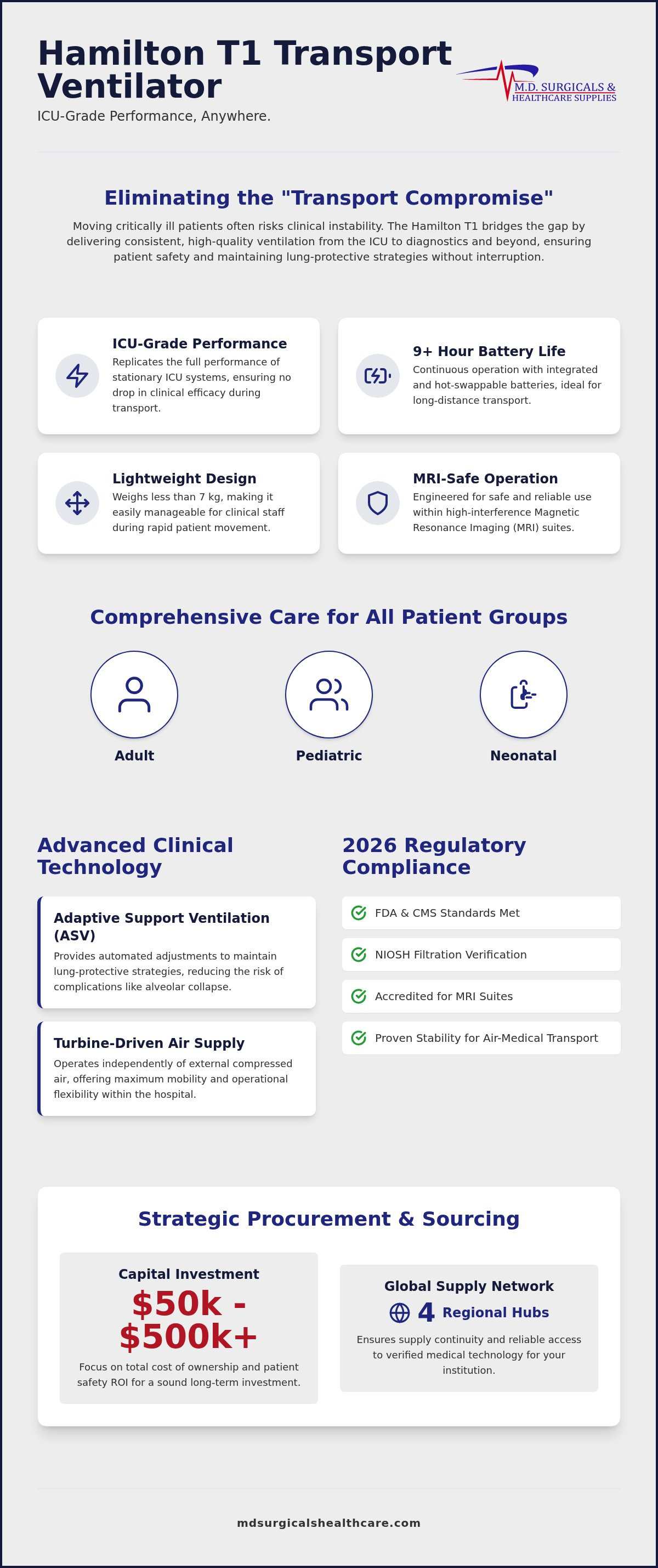
The "transport compromise" is no longer a necessary risk in modern critical care medicine. You recognize that moving a hemodynamically unstable patient from the Intensive Care Unit (ICU) to a diagnostic suite often introduces clinical instability, particularly when switching between disparate ventilation platforms. Maintaining the same level of lung-protective strategy during intra-hospital transport is vital for patient safety and operational efficiency. This article provides a professional deep dive into the Hamilton T1 transport ventilator, a device engineered to maintain ICU-grade performance during every phase of patient movement.
You'll gain a comprehensive understanding of its technical specifications, clinical applications, and the logistics of securing these units for your institution. We examine its turbine-driven air supply, compatibility with Magnetic Resonance Imaging (MRI) environments, and its suitability for three patient groups:
- Adult patients
- Pediatric patients
- Neonatal patients
We also detail compliance with September 2026 Food and Drug Administration (FDA) and Centers for Medicare & Medicaid Services (CMS) standards. From its nine hour battery life to its simplified interface, we explore why this platform is a strategic asset for healthcare facilities managing equipment budgets in the $50,000–$500,000+ range. Finally, we discuss how to leverage a global distribution network to ensure supply continuity before wards run short.
Key Takeaways
- Understand how the Hamilton T1 transport ventilator utilizes Adaptive Support Ventilation (ASV) to provide ICU-grade care without the need for external compressed air.
- Identify the critical features that allow for seamless patient transitions between the ICU, emergency transport, and Magnetic Resonance Imaging (MRI) environments.
- Review the essential September 2026 regulatory standards and clinical benchmarks required for modern transport ventilation systems.
- Analyze procurement strategies for equipment in the $50,000–$500,000+ range to optimize hospital ROI and patient safety outcomes.
- Learn how to maintain operational continuity by sourcing verified medical technology through a global network spanning four regional hubs.
Defining the Role of Transport Ventilation in September 2026
Transport ventilation involves providing continuous mechanical ventilation support as a patient moves between different clinical environments. In September 2026, the standard of care dictates that there should be no drop in clinical efficacy during these transitions. Moving a patient from the ICU to a CT scanner or across hospital wings often exposes them to physiological risks. The Hamilton T1 transport ventilator bridges this gap by offering a portable solution that replicates the performance of stationary systems. Procurement managers now prioritize devices that minimize these clinical gaps to improve patient outcomes and reduce the length of stay.
The Evolution of Critical Care Transport
Transport devices have evolved from simple pneumatic triggers to intelligent, microprocessor-controlled systems. Early models often lacked the precision to maintain specific lung-protective strategies. You'll find that maintaining Positive End-Expiratory Pressure (PEEP) is one of the most critical factors during a move. Manual bagging or using inferior units often leads to alveolar collapse and lung injury. The Hamilton T1 transport ventilator provides automated adjustments to prevent these complications. It ensures that the patient's respiratory drive remains stable regardless of the physical environment, which is a significant leap from older, manual methods.
Key Regulatory Standards for 2026
Institutional reliability depends on strict adherence to modern safety protocols. As of September 2026, transport ventilators must meet rigorous FDA (Food and Drug Administration) and CMS (Centers for Medicare & Medicaid Services) guidelines to remain in clinical service. These regulations ensure that portable hardware can withstand the electrical and physical demands of diverse hospital zones. Choosing a platform that meets these 2026 benchmarks is a strategic move for long-term operational continuity.
Key compliance factors include:
- Verification of NIOSH (National Institute for Occupational Safety and Health) standards for filtration and safety.
- Accreditation for use in high-interference areas like MRI suites.
- Proof of stability during rapid altitude changes for air-medical transport.
Procurement professionals must look beyond the initial purchase price. You need to evaluate the total cost of ownership, including consumables and maintenance. The ability to use a single circuit from the ICU to the transport unit reduces waste and saves time for clinical staff. Investing in accredited and verified hardware protects your institution from liability while ensuring patient safety. High-end systems typically represent a capital investment in the $50,000–$500,000+ range. Selecting a device that integrates with your existing patient monitors ensures a unified data stream, which is essential for modern electronic health records.
Technical Specifications: ICU-Grade Care in a Portable Frame
The Hamilton T1 transport ventilator provides clinical parity with stationary ICU systems while maintaining a compact form factor. It weighs less than seven kilograms, making it one of the most portable high-end units available for critical care teams. In September 2026, the latest models feature a battery capacity designed for over nine hours of continuous operation.
This endurance is achieved through a combination of an integrated battery and a hot-swappable secondary unit. This power management system eliminates the anxiety of energy depletion during long-distance air-medical transport or extended diagnostic procedures. It ensures that the patient's respiratory support remains uninterrupted throughout the entire clinical journey.
One of the most significant engineering feats of the Hamilton T1 transport ventilator is the integrated high-performance turbine. This allows the device to operate entirely independently from compressed air. You don't need to worry about the logistical burden of heavy gas cylinders during complex intra-hospital transfers. This independence is a primary reason why the unit is favored for both civilian emergency medical services and military applications.
Intelligent Ventilation Technologies
The heart of the system is Adaptive Support Ventilation (ASV). This mode automatically adjusts the respiratory rate and tidal volume based on the patient's real-time lung mechanics. It ensures the patient receives efficient ventilation while minimizing the risk of lung injury. This automation reduces the clinician's workload by managing weaning protocols.
The hardware is specifically ruggedized for movement. While it shares several high-end features with the Hamilton C6 Ventilator, the T1 is optimized for vibration and impact resistance. This makes it a reliable choice for the most demanding transport environments.
Monitoring and User Interface
The high-resolution touch screen is specifically designed for use with medical gloves. Through the Ventilation Cockpit, you can view real-time lung mechanics and waveforms on a single screen. This interface reduces the risk of operator error during high-stress scenarios. It provides the clarity needed for quick decision-making.
The alarm management system also prioritizes critical changes in patient status. It filters non-essential data to prevent alarm fatigue among clinical staff. If you are evaluating how these specifications fit your facility's current fleet, you can speak with our technical consultants for a detailed analysis of your procurement needs.
Clinical Versatility: Emergency, Intra-Hospital, and MRI
The Hamilton T1 transport ventilator is engineered to function as a clinical bridge across diverse medical environments. It provides the same high-end ventilation performance found in stationary ICU units, which is essential for maintaining patient stability. You can use this device for adult, pediatric, and neonatal patients, ensuring a single platform meets the needs of your entire facility. This versatility is particularly valuable for Emergency Medical Services (EMS) and air-medical teams who require consistent results in unpredictable settings.
One of the primary advantages is the parity it offers with ICU settings. Clinical staff can perform seamless transfers without the need to change ventilator circuits. This continuity reduces the time a patient spends in a vulnerable state during the move. It also allows for specialized compatibility within the MRI suite. You won't face diagnostic delays because the ventilator is designed to operate safely near high-field magnets, ensuring that even the most critical patients receive necessary imaging without compromising their respiratory support.
Intra-Hospital Transfer Protocols
Maintaining stable oxygenation during movement to CT or MRI imaging zones is a significant challenge for any clinical team. The Hamilton T1 transport ventilator helps reduce the incidence of Ventilator-Associated Pneumonia (VAP) by minimizing the need to disconnect the patient from the circuit. Every time a circuit is opened, the risk of contamination increases. By using a transport unit that matches ICU efficacy, you maintain lung-protective strategies throughout the procedure. If your institution handles smaller-scale clinical needs or less complex transfers, you might also consider the Hamilton C1 Mechanical Ventilator as a complementary option for your fleet.
Extreme Environment Performance
Critical care doesn't always happen in a controlled hospital wing. This device features a ruggedized housing that complies with military-grade shock and vibration standards, specifically MIL-STD-810G. It operates reliably at high altitudes up to 25,000 feet, which is a requirement for aero-medical evacuation teams. The hardware remains stable in extreme temperatures ranging from -15 to 50 degrees Celsius. These specifications ensure that whether you're in a pressurized cabin or a ground ambulance, the delivery of life-sustaining air remains precise. The IP54 rating further protects the internal components from splashing water or dust, making it a dependable partner in the field.
Strategic Procurement: Pricing, Accreditation, and Verification
Procurement of high-end ventilators like the Hamilton T1 transport ventilator requires a strategic approach to capital expenditure. These systems typically fall within the $50,000–$500,000+ price range, depending on the volume and configuration required for your institution. Evaluating Return on Investment (ROI) involves more than the initial purchase price. You must account for reduced patient stay duration and the mitigation of clinical complications during transport. High-quality ventilation during movement prevents secondary lung injuries that otherwise extend recovery times. Improved outcomes directly impact the hospital's bottom line and patient safety scores.
Understanding the Total Cost of Ownership
A comprehensive procurement strategy factors in long-term operational costs. This includes consumables such as breathing circuits, regular maintenance schedules, and ongoing training for clinical staff. Market data from September 2026 indicates a significant shift toward multi-functional transport units that can serve multiple patient populations. You'll find that investing in a versatile platform reduces the need for redundant specialized equipment. Large hospital networks often benefit from wholesale procurement strategies rather than retail acquisitions. This approach ensures supply continuity and better logistical support across multiple regional hubs.
Verification and Compliance Checkpoints
Supply chain integrity is paramount when acquiring life-critical hardware. All equipment must be accredited and verified before sale to comply with September 2026 healthcare mandates. Sourcing from a licensed distributor guarantees that the devices meet international safety standards and have undergone rigorous quality checks. This prevents the operational risks associated with unverified gray-market equipment. We maintain a legacy built over many years as a trusted partner in medical supply distribution. This ensures that your facility receives hardware that is both clinically ready and legally compliant.
Secure procurement also extends to the digital transaction itself. We ensure that all institutional orders are protected by 128-bit SSL encryption (Secure Sockets Layer). Our systems adhere to PCI DSS compliant checkout (Payment Card Industry Data Security Standard) to maintain the highest levels of financial security. This meticulousness in both product verification and transaction safety builds the foundation of a reliable logistical partnership. It allows procurement managers to focus on clinical needs rather than administrative security concerns.
Sourcing the Hamilton T1 through M.D. Surgicals & Healthcare Supplies
Acquiring the Hamilton T1 transport ventilator requires a partner who understands the logistical pressures of the modern healthcare environment. M.D. Surgicals & Healthcare Supplies operates as a strategic logistical backbone for institutions worldwide. We've built a legacy over many years as a trusted distributor of surgical and medical supplies. Our institutional approach ensures that you aren't just buying a device; you're securing a reliable supply chain. Our customer promise is simple: Low Prices · Large Selection · Satisfaction Guaranteed · Secure Shopping.
Global Distribution and Logistics
Our infrastructure is designed for speed and reliability across four regional hubs: NORAM, LATAM, EMEA, and APAC. This global network ensures that critical hardware is shipped before your ward runs short of essential equipment. We support international procurement teams in multiple languages to streamline the acquisition process. You can review our Shipping Policy to understand specific global delivery timelines for your region. This methodical approach to distribution minimizes downtime and maintains operational continuity in high-stakes clinical settings.
Secure Institutional Procurement
We prioritize the security of your data and financial transactions. Our platform utilizes 128-bit SSL encryption for all online quote requests and communications. This level of protection is vital when handling sensitive institutional procurement details. If you're managing bulk orders or complex fleet upgrades, our dedicated supply specialists are available at +1 (510) 470-1367 to assist you. You'll have direct access to experienced regional sales managers, such as Mr. Lucas A. Everhart in our NORAM hub, who understands the specific regulatory requirements of your territory.
Our team provides the administrative clarity needed to finalize large-scale capital investments. We invite you to contact our team for a personalized consultation. We'll provide a detailed quote on the Hamilton T1 transport ventilator that reflects your institution's specific volume and logistical needs. This consultative dialogue ensures that the technology you receive is perfectly aligned with your clinical objectives and budgetary constraints for September 2026 and beyond.
Advancing Clinical Mobility and Institutional Reliability
Integrating the Hamilton T1 transport ventilator into your facility's fleet eliminates the clinical compromise often associated with patient movement. You ensure that ICU-level care remains constant during every intra-hospital transfer and MRI procedure. This continuity is essential for improving patient outcomes and meeting the rigorous safety standards set for September 2026. By prioritizing high-end ventilation in the $50,000–$500,000+ range, you protect your most vulnerable patients from transport-related instability. It's a strategic investment in both safety and efficiency.
Strategic procurement through a licensed partner provides the logistical stability your supply chain needs. We offer accredited and verified equipment across our global distribution network of four regional hubs. Every transaction is secured through a PCI DSS compliant checkout process to protect institutional data and financial integrity. Our team is ready to assist you in navigating the technical specifications and procurement logistics required for a seamless transition to advanced transport ventilation.
We look forward to supporting your institution's commitment to clinical excellence and operational continuity through our global network.
Frequently Asked Questions
What is the battery life of the Hamilton T1 in 2026 models?
The Hamilton T1 transport ventilator provides up to nine hours of operating time in 2026 models. This endurance is achieved through a combination of one integrated battery and one hot-swappable battery. Clinical teams can replace the secondary battery during operation without interrupting ventilation. This feature is essential for long-distance air-medical evacuations or extended diagnostic procedures where external power sources are unavailable. It ensures patient safety throughout the entire transport duration.
Is the Hamilton T1 ventilator MRI compatible?
Yes, the Hamilton T1 is specifically designed for compatibility within the MRI suite. It allows for the continuous ventilation of critically ill patients during diagnostic imaging without the risk of electromagnetic interference. This specialized engineering prevents delays in diagnosis and treatment. Clinical staff can maintain the same level of respiratory support from the ICU directly into the imaging zone. This seamless transition reduces the risk of lung injury during high-risk transfers.
What is the expected price range for a Hamilton T1 transport ventilator?
High-end ventilators like the Hamilton T1 typically fall within the $50,000–$500,000+ price range for institutional procurement. This pricing reflects the advanced microprocessor controls and ruggedized hardware required for critical care transport. Procurement managers should evaluate the total cost of ownership, including consumables and long-term maintenance. Sourcing through a licensed distributor ensures that your facility receives wholesale value on verified, accredited hardware. We provide customized quotes based on your specific institutional volume requirements.
Does M.D. Surgicals verify the accreditation of ventilators before sale?
Yes, M.D. Surgicals ensures that all products are accredited and verified before sale. We operate as a licensed distributor to maintain the highest standards of clinical safety and regulatory compliance. This verification process is a core pillar of our logistical operations. It protects your institution from the risks associated with unverified hardware. You can trust that every device in our catalog meets the necessary healthcare mandates for September 2026 and beyond.
Can the Hamilton T1 be used for neonatal patients?
The Hamilton T1 transport ventilator is approved for use with adult, pediatric, and neonatal patients. It features specialized ventilation modes and sensors designed to manage the delicate lung mechanics of neonates. This versatility allows healthcare institutions to use a single, standardized platform across different departments. It simplifies training for clinical staff and reduces the need for multiple specialized transport units. The device provides the precision required for even the most sensitive patient populations.
How does the Hamilton T1 turbine-driven system benefit transport?
The turbine-driven system allows the ventilator to operate independently from compressed air. This independence eliminates the need for heavy gas cylinders during intra-hospital or emergency transport. The integrated high-performance turbine delivers the necessary flow and pressure for ICU-grade ventilation in any environment. It reduces the logistical burden on transport teams and ensures that life-sustaining support isn't limited by gas supply. This technology is vital for both air-medical and ground transport scenarios.
What regional hubs does M.D. Surgicals operate for global shipping?
M.D. Surgicals operates a global network across four regional hubs to ensure efficient distribution. These hubs are located in the NORAM (USA), LATAM (Brazil), EMEA (France), and APAC (India) regions. This infrastructure allows us to ship medical equipment and consumables before your ward runs short. Each hub is managed by dedicated regional sales leaders who understand local regulatory requirements. This global presence ensures that we can support healthcare facilities on every continent.
Are the transactions on the M.D. Surgicals website secure?
All transactions on our website are protected by 128-bit SSL encryption to ensure data security. We also utilize a PCI DSS compliant checkout process to safeguard your financial information during procurement. These security protocols are standard for every order, from small consumables to high-end imaging systems. We prioritize the integrity of your institutional data throughout the entire purchasing process. This commitment to security allows you to manage procurement with complete administrative confidence.


